Our presbytery met last week in Orlando, Florida. Presbytery accomplishes a lot of good and necessary work, but the most significant thing we did last week was to honor the lifetime ministry work of Dr. Roy Blackwood. Dr. Blackwood officially requested, and was granted, that his resignation as senior pastor at Second RPC in Indianapolis be received. Although that part of the evening was a very sad occasion, the receiving of his resignation was followed by Pastor Keith Magill giving a long testimony concerning Dr. Blackwood's ministry and work. For me, three things shone through the evening.
First, the amount of work God has used Dr. Blackwood to accomplish is truly amazing. When he began pastoring in the 1950's, there was only one Reformed Presbyterian Church in Indiana. Now there are nine, all of which have the stamp of his passion and ministry upon them. Even our new church, Immanuel, owes honor to Dr. Blackwood; though he did not participate in the planting of this congregation, he helped plant our mother church and he helped instill the vision in that session and in our presbytery for continual church planting.
Second, the testimony of so many men and women include how Jesus used Dr. Blackwood in their lives. Several of the pastors spoke at a reception, revealing how Dr. Blackwood's passion for the church as a whole was equaled (if not surpassed) by his love for people as individuals. He was and remains a disciple-maker, calling and training many men for the pastorate and many more for lives devoted to Christ in other vocations.
Third, and perhaps the most moving, was Dr. Blackwood's reason for resigning his pastorate. His dear wife, Margie, was able to be there that evening with us and he recognized her commitment to and help for his ministry. This resounds in so many pastors' hearts, that "without her, I could not have done any of it." Fact is, Mrs. Blackwood needs more and more help these days. And Dr. Blackwood resigned in order to receive his promotion to taking care of her full time, this helpmate who took care of him for so many decades of ministry.
I'm sure Dr. Blackwood doesn't read blogs. If he did, he probably wouldn't like this post. At least not unless I end it the right way, by giving the honor to Christ rather than to Roy. This is his greatest testimony to me, that in everything, Jesus should receive the glory. It's not Roy's church or your church or my church. It's Jesus' church.
Showing posts with label church. Show all posts
Showing posts with label church. Show all posts
04 March 2008


16 November 2007
Jesus Camp - Some thoughts
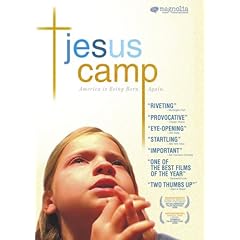
I picked up Jesus Camp last week at the library and have some thoughts I'd like to get down before they're gone.
A summary: Jesus Camp is a documentary about a Pentecostal youth minister, Becky Fischer, her "Kids on Fire" youth camp in North Dakota with a focus on a few of the kids attending, all framed by reaction from a radio talk-show host (a self-professed moderate Christian) who's quite alarmed at the idea of kids becoming Christian soldiers in "God's army." The camp specializes in training young children to "take back America," while also whipping them into an emotional, tongue-speaking, ecstatic state. So, clearly, there's nothing controversial here. Just move along.
[Side note: the documentary includes sermon footage from Ted Haggard, proclaiming the normal, Republicanized Christianity. After this film's release, Haggard was released from his pastorate in the midst of accusations from a homosexual prostitute. In the sermon clip, homosexuality was one of the specific sins he spoke against. In the wake of his personal sin, the film clip is both ironic and terribly tragic.]
Here are some thoughts, in no particular order:
- I thought the documentary was about as fair-minded as one could be trying to record something like this. There was no overdubbing, all-knowing narrator and there were only a few explanatory notes along the way (i.e., "Evangelical Christians believe one must be born again by faith in Christ to be saved."), most of which were accurate, if simplistic. So the directors (Heidi Ewing and Rachel Grady) should be commended for that.
- Having never really been around much charismatic Christianity, the film was a real eye-opener for me. Several times I found my mouth open and my eyes wide at how different this type of Christian life is.
- Despite her obvious love for the children and strong faith in her message, Becky Fischer's teaching strategy was thoroughly manipulative rather than Scriptural. Clips of teaching kids how to speak in tongues ("just open your mouth and let the Spirit flow through you!") and young children crying in fear of Satan all made me quite sad. Even if the parts of the camp they left out were filled with solid, Biblical and reformed teaching, I still wouldn't send my kids within 10 miles of the camp. The problem lies not just with Fischer, but with the hyper-emotional, unbiblical and manipulative tendencies of charismatic Christianity.
- I shudder to think that the outside world, looking in at the church, thinks the evangelical church is all like this. But yet we are joined in some way to Becky Fischer and the charismatic-evangelical churches. Until we are ready to disavow them as Christians at all, they are our brothers and sisters. And so I find myself in the odd position of being embarrassed by our own extended family. It make me hesitant to write these thoughts in public, because I don't like the idea of airing our familial grievances before the world. Yet there is, I trust, another branch of the American evangelical church, one not beholden to the Republican party, one steeped in Scriptures rather than emotional experience, one ready to engage the world thoughtfully and Biblically - and somehow I want the world to know about that part, too.
- One of the homeschooling moms interviewed had a solid and reasonable defense of homeschooling her children. I was glad for this.
- Watching a young girl (7 or 8) take a tract to an adult woman in a bowling alley, stumble through the most awkward gospel presentation ever ("God just wants to love you and you'll be happy and Jesus died for you and...") and walk away assured that she has done what God wanted ("I just heard Him speak to me...") must be one of the most uncomfortable moments I've ever seen on film. But when was the last time I had the courage to approach a stranger to proclaim the gospel?
- The passion for and focus on the children should also be commended. Fischer and her church is entirely right to believe the future of our nation and culture lies with our children. That belief is good and right; it's how they work it out that poses the danger of zeal without knowledge.
- That this movie is rated PG-13 is quite interesting. As far as I can tell, it's because of some discussions of abortion. But even then...
11 November 2007
How spirituality will kill the church
I love the Weekend Journal. On Fridays and Saturdays, the Wall Street Journal includes this section of movie reviews, book reviews, art lessons, political commentary (Peggy Noonan) and other assorted goodies. If we ever stop getting the Journal, I'll probably still go out and buy it on the weekend just for this section. For me, the most important column is the weekly "Houses of Worship" column, authored by various writers, giving quite wide-ranging thoughts on religion.
This week's column ("Buddhist Boomers: A Meditation" by Clark Strand) really has nothing to do with Christianity, which is of course my religion. Except that between the lines of the article is a potent prophecy for American Christianity about her incessant desire to flirt with the world ('cause, y'know, if they like us, maybe they'll invite us to the party!).
Here's the scoop: Among the major religions (Christianity, Judaism, Islam), Buddhism stands as the only one the rest of the country is comfortable with. Even Sam Harris, one of the new evangelistic atheists, doesn't mind Buddhism so much "because it is not a religion of faith, or a religion at all in the Western sense."
The problem Buddhism faces is one of aging and eventual extinction. Most American converts to Buddhism are over 50 years old. Worse yet (for the religion, that is), these converts have no concrete sense at all of what it means to be Buddhist. They know nothing about Buddhist baptisms, weddings or funerals. The version of Buddhism they practice is a "thought experiment" more than a true religion; that is, it is an active attempt at a peaceful, tolerant form of spirituality trying to find a home in the intolerant, hypermodern world. Problem is, without the religious part of the religion, without baptisms and rules, funerals and rites, there is nothing to pass onto children except a vague sense of spirituality. And so young Buddhist children have a vague sense that their parents want them to be spiritual, too (but nothing too specific, lest anyone charge the parents with abusive brainwashing).
Therein lies the parable for the church. Quite in vogue is all this talk about spirituality versus religion. (Exhibit A: Blue Like Jazz: Nonreligious thoughts on Christian Spirituality, by Donald Miller. Exhibit B: every other Christian radio preacher proclaiming "Christianity is a relationship, not a religion!") As the church continues to lose relevance by chasing it, she is more and more capitulating by refusing to speak of "religion" and focusing solely on "spirituality." Loaded terms, to be sure. But here's what I think folks like Donald Miller mean: religion is what constrains us and restricts us, defining us with rules and rites. Spirituality is what sets us free to be what we're meant to be in Christ.
For these anti-religious Christians, Buddhism is now waving the yellow flag. If we lose the religion and attempt to keep the spirituality, we will end up with neither. While this anti-religious spurt may really tickle you, it will mean nothing to your children because there can be no substance without form. It is religion we pass onto our children and it is Spirituality which the Holy Spirit imparts through the ordained means of grace (y'know, those rules and rituals that seem so confining).
Can the church be too religious and not spiritual enough? Absolutely. But the answer is not to abandon the foundation for the upper story. The answer is to use the rites and rituals and means of grace to the end for which God intended: radical spirituality. Just because your car smells a little funny doesn't mean you should stand in your driveway, hoping magically to appear at the Grand Canyon. God has ordained one to get to the other. Give up the car and you can't go anywhere. Give up the religion and spirituality becomes a vapor to chase.
This week's column ("Buddhist Boomers: A Meditation" by Clark Strand) really has nothing to do with Christianity, which is of course my religion. Except that between the lines of the article is a potent prophecy for American Christianity about her incessant desire to flirt with the world ('cause, y'know, if they like us, maybe they'll invite us to the party!).
Here's the scoop: Among the major religions (Christianity, Judaism, Islam), Buddhism stands as the only one the rest of the country is comfortable with. Even Sam Harris, one of the new evangelistic atheists, doesn't mind Buddhism so much "because it is not a religion of faith, or a religion at all in the Western sense."
The problem Buddhism faces is one of aging and eventual extinction. Most American converts to Buddhism are over 50 years old. Worse yet (for the religion, that is), these converts have no concrete sense at all of what it means to be Buddhist. They know nothing about Buddhist baptisms, weddings or funerals. The version of Buddhism they practice is a "thought experiment" more than a true religion; that is, it is an active attempt at a peaceful, tolerant form of spirituality trying to find a home in the intolerant, hypermodern world. Problem is, without the religious part of the religion, without baptisms and rules, funerals and rites, there is nothing to pass onto children except a vague sense of spirituality. And so young Buddhist children have a vague sense that their parents want them to be spiritual, too (but nothing too specific, lest anyone charge the parents with abusive brainwashing).
Therein lies the parable for the church. Quite in vogue is all this talk about spirituality versus religion. (Exhibit A: Blue Like Jazz: Nonreligious thoughts on Christian Spirituality, by Donald Miller. Exhibit B: every other Christian radio preacher proclaiming "Christianity is a relationship, not a religion!") As the church continues to lose relevance by chasing it, she is more and more capitulating by refusing to speak of "religion" and focusing solely on "spirituality." Loaded terms, to be sure. But here's what I think folks like Donald Miller mean: religion is what constrains us and restricts us, defining us with rules and rites. Spirituality is what sets us free to be what we're meant to be in Christ.
For these anti-religious Christians, Buddhism is now waving the yellow flag. If we lose the religion and attempt to keep the spirituality, we will end up with neither. While this anti-religious spurt may really tickle you, it will mean nothing to your children because there can be no substance without form. It is religion we pass onto our children and it is Spirituality which the Holy Spirit imparts through the ordained means of grace (y'know, those rules and rituals that seem so confining).
Can the church be too religious and not spiritual enough? Absolutely. But the answer is not to abandon the foundation for the upper story. The answer is to use the rites and rituals and means of grace to the end for which God intended: radical spirituality. Just because your car smells a little funny doesn't mean you should stand in your driveway, hoping magically to appear at the Grand Canyon. God has ordained one to get to the other. Give up the car and you can't go anywhere. Give up the religion and spirituality becomes a vapor to chase.
04 May 2007
Here we go
This is why I really like Carl Trueman: he says stuff everyone else thinks but doesn't say. I would love to hear some thoughts on this post at Ref21's blog:
What do you think?
In the US (and it is the US -- I have not seen this so much in the UK) , I
have lost count of the number of women I have come across, particularly in
presbyterian circles, who feel the need to conform to some Reformed cultural
norm. You can tell them on the Sundays: the exhausted and haggard mothers
whose husbands expect them not only to cook and to clean, but also to
home-school the kids. For every omnicompetent wife who seems to be able to
run the world and then some, and still look like a million dollars when hubbie
gets home for dinner (already on the table, of course), there are ten or more
who look crushed and dispirited, who really need to send their kids out of the
house in the morning so they can get some rest and some mental sanity, who need
their husbands to see the problem and take steps to help them. Are they
inadequate as Christian mothers? No. They are crushed by a
"Christian" culture that demands their all and gives no slack.
I am no feminist (my wife will confirm my impeccable Neanderthal
credentials); I have strong views on women's ordination; but I am saddened by
the way Reformed church culture so often tramples its women underfoot with its
mindless identification of biblical manhood with something akin to John Wayne
and its assumption that all Christian women should make Mary Poppins look
domestically incompetent.
What do you think?
01 March 2007
More on Creeds & Catechisms
Here is Carl Trueman on creedal middle ground (read the whole article here):
Our mid-week small group is continuing to benefit from a slow, careful study of the doctrines of Scripture using the outline provided by the Nicene Creed. And our evening teaching services at Immanuel are structured on the outline provided by the Shorter Catechism. This is on purpose and it is not because we don't believe in Sola Scriptura. On the contrary, it is because we believe so strongly in Sola Scriptura that we value the roadmaps God has providentially provided to His church throughout the centuries.
Creeds and confessions will, I suspect, continue to suffer at the hands ofAnd this from Gregory Reynold's in OPC's Ordained Servant: (thanks, Nick)
friend and foe alike. The latter will always dismiss them as encroaching on
scripture’s authority; the former will continue to make them narrower and
functionally more important than they were ever intended. But on this issue I
believe there is a middle way, which gives peculiar but subordinate status to
such documents, and which also sees a place for occasional, transdenominational
statements as well. The church must never compromise the unique authority of the
Bible, must always focus on the basic essentials which cross time and space, but
must also speak thoughtfully, to the here and now. Historic creeds and
contemporary declarations thus both have their part to play in making the
church’s voice a relevant voice. Until we realize that, I fear that a good creed
will seldom go unpunished.
When Washington's troops built their fortifications in Brooklyn, he
insisted that they explore the terrain before battle in order to be surefooted
during the rapid movements often required in the fight. Likewise catechizing
should be a chief concern of the church militant...Just as no one confuses a map
with the reality of the terrain it depicts, so we understand that the Satechism
helps us understand the terrain of the Bible itself. It is not a stand-alone
source of truth. So, reading the Bible confirms the terrain, just as traveling
confirms the accuracy of a map. A map teaches us what to look for and keeps us
from getting lost.
Our mid-week small group is continuing to benefit from a slow, careful study of the doctrines of Scripture using the outline provided by the Nicene Creed. And our evening teaching services at Immanuel are structured on the outline provided by the Shorter Catechism. This is on purpose and it is not because we don't believe in Sola Scriptura. On the contrary, it is because we believe so strongly in Sola Scriptura that we value the roadmaps God has providentially provided to His church throughout the centuries.
19 February 2007
Books
So for my absence from your bright, shiny screens. Like most of you, life and snow combine to render me busy...but not too busy to read, of course.
-----
 Mark Dever's ministry philosophy 9 Marks of a Healthy Church has turned into the foundation for a wide-reaching ministry aimed at revitalizing lagging chruches or simply kicking them in their Biblical keisters. At their website, 9Marks presents a great resource of articles, book reviews, and audio interviews - any pastor would do well to bookmark their site and use it as a source of encouragement and learning.
The book that started it all is centered around Pastor Dever's (Capitol Hill Baptist Church in D.C.) conception of what a healthy church looks like:
The negative side of the book is not any of the teaching, but the simplicity of the teaching. As Dr. Dever aims at helping the church by convincing her leaders of what a Biblical church looks likeI think he could have delved into the Biblical teaching on these topics more significantly than he did. One of the blurbs on the back reports that Nine Marks is required seminary reading, which is disappointing - again, not because of the book's faithfulness, but because of its simplicity. Readers who are presbyterian by conviction will find a few other points to quibble with, as Dr. Dever writes from a muted-but-present Baptist background.
I did enjoy this book and appreciate the reason it was written; originally, I read it to see if it was something our session could benefit from reading together. In the end, I decided to go with something more consciously presbyterian and pastoral, John Sittema's With a Shepherd's Heart. Nine Marks is a fine book of solid ecclesiology; perhaps it might become the basis for a more in-depth book in the future.
-----
 The Enemy Within by Kris Lundgaard is a highly readable, extremely helpful book about our fight against sin. Lundgaard begins by acknowledging his dependence on the venerable John Owen, whose two books, Mortification of Sin and Indwelling Sin, form the theological backbone of this book. Anyone who has read John Owen realizes the great work Lundgaard has accomplished by making Owen's dense, theological, Puritan writing easily understandable.
The problem of sin faces every believer and it doesn't always make sense - "In what sense has Christ defeated sin in the believer?" The answer is that he has overthrown its rule, weakened its power, and even killed its root so that it cannot bear the fruit of eternal death in a believer. Still - and this is amazing but true - sin is sin; its nature and purpose remain unchanged; its force and success still grab us by the throat.
Through a series of short chapters (with discussion questions included at the end), the author begins by examining the power of sin in a believer - what is it, how does it work? As I read this, I felt like I was getting a sneak peek at the enemy's playbook, or as Bryan Chapell put it, a "remarkable reconnaissance mission behind enemy lines..." If Lewis' Wormwood and Screwtape were devils conniving against a soul from the outside, Lundgaard would have us also recognize the incredible enemy lying inside - what the Apostle Paul calls our flesh.
Throughout the book and especially toward the end, Lundgaard is our general in the battle against sin, teaching us to use our weapons against sin, teaching us to keep our eyes on Christ - especially His cross - and encouraging us to never let up in the battle.
The Enemy Within can be read in short order (I shot through it in a couple plane rides) - but should really be read slowly. The Biblical teaching in this book is exactly what need for the ever-present battle against sin - and is best digested through meditation and prayer.
I cannot recommend this book highly enough; for you who read it, you will likely be spurred on to read John Owen's writings as a followp-up, which is an added benefit. The Enemy Within would be a great book for accountability partners, small groups, men's groups, etc. For the good of your soul and the purity of the church, read this wonderful book!
-----
 Mark Dever's ministry philosophy 9 Marks of a Healthy Church has turned into the foundation for a wide-reaching ministry aimed at revitalizing lagging chruches or simply kicking them in their Biblical keisters. At their website, 9Marks presents a great resource of articles, book reviews, and audio interviews - any pastor would do well to bookmark their site and use it as a source of encouragement and learning.
The book that started it all is centered around Pastor Dever's (Capitol Hill Baptist Church in D.C.) conception of what a healthy church looks like:
- Expositional preaching
- Biblical theology
- The gospel
- A Biblical understanding of conversion
- A Biblical understanding of evangelism
- A Biblical understanding of church membership
- Biblical church discipline
- A concern for discipleship and growth
- Biblical church leadership
The negative side of the book is not any of the teaching, but the simplicity of the teaching. As Dr. Dever aims at helping the church by convincing her leaders of what a Biblical church looks likeI think he could have delved into the Biblical teaching on these topics more significantly than he did. One of the blurbs on the back reports that Nine Marks is required seminary reading, which is disappointing - again, not because of the book's faithfulness, but because of its simplicity. Readers who are presbyterian by conviction will find a few other points to quibble with, as Dr. Dever writes from a muted-but-present Baptist background.
I did enjoy this book and appreciate the reason it was written; originally, I read it to see if it was something our session could benefit from reading together. In the end, I decided to go with something more consciously presbyterian and pastoral, John Sittema's With a Shepherd's Heart. Nine Marks is a fine book of solid ecclesiology; perhaps it might become the basis for a more in-depth book in the future.
-----
 The Enemy Within by Kris Lundgaard is a highly readable, extremely helpful book about our fight against sin. Lundgaard begins by acknowledging his dependence on the venerable John Owen, whose two books, Mortification of Sin and Indwelling Sin, form the theological backbone of this book. Anyone who has read John Owen realizes the great work Lundgaard has accomplished by making Owen's dense, theological, Puritan writing easily understandable.
The problem of sin faces every believer and it doesn't always make sense - "In what sense has Christ defeated sin in the believer?" The answer is that he has overthrown its rule, weakened its power, and even killed its root so that it cannot bear the fruit of eternal death in a believer. Still - and this is amazing but true - sin is sin; its nature and purpose remain unchanged; its force and success still grab us by the throat.
Through a series of short chapters (with discussion questions included at the end), the author begins by examining the power of sin in a believer - what is it, how does it work? As I read this, I felt like I was getting a sneak peek at the enemy's playbook, or as Bryan Chapell put it, a "remarkable reconnaissance mission behind enemy lines..." If Lewis' Wormwood and Screwtape were devils conniving against a soul from the outside, Lundgaard would have us also recognize the incredible enemy lying inside - what the Apostle Paul calls our flesh.
Throughout the book and especially toward the end, Lundgaard is our general in the battle against sin, teaching us to use our weapons against sin, teaching us to keep our eyes on Christ - especially His cross - and encouraging us to never let up in the battle.
The Enemy Within can be read in short order (I shot through it in a couple plane rides) - but should really be read slowly. The Biblical teaching in this book is exactly what need for the ever-present battle against sin - and is best digested through meditation and prayer.
I cannot recommend this book highly enough; for you who read it, you will likely be spurred on to read John Owen's writings as a followp-up, which is an added benefit. The Enemy Within would be a great book for accountability partners, small groups, men's groups, etc. For the good of your soul and the purity of the church, read this wonderful book!
06 February 2007
Immanuel
I know everyone's thinking and writing about the Colts winning the Super Bowl. But something much more important happened last weekend.
Friday night the Great Lakes/Gulf presbytery of the RPCNA met to organize Immanuel Reformed Presbyterian Church as a particular congregation. It was a great night of worship and rejoicing in the greatness of God. Pastor Barry York preached for us from Psalm 45, on our call as a daughter church to "forsake our people and our father's house" and our mother church's great sacrifice of sending a daughter away from her in order to pursue Christ's kingdom. James Faris, pastor of the Southfield (MI) RPC, prayed the prayer of constitution, and Immanuel became a congregation - we start with 38 communicant members and 32 baptized members.
Two men were elected as ruling elders: David Carr, who was a ruling elder in Lafayette, and Ben Larson. I might be more excited about this than anyone else - I am, perhaps, an incurable presbyterian. I'm so glad to have men to work alongside with, men to keep me accountable and watch over souls with me.
The service was wonderful. And wonderfully long - it takes Presbyterians a while to do something like this. At one point, Pastor Faris reminded us that, though the world was focusing their attentions on a football game, what we were doing that night would be remembered for eternity because it was of eternal significance.
Sunday was our first full day of worship together. Though it feels weird and a little "off" to not be worshipping in the Lafayette church, it was an exciting day. In our morning worship, I began a sermon series examining the theme of Immanuel throughout Scripture. In our evening teaching service, we're studying through the Westminster Shorter Catechism.
If we come to mind, pray that God might use us for His glory and purposes, that the kingdom of Christ would come in West Lafayette as it is in heaven.
Friday night the Great Lakes/Gulf presbytery of the RPCNA met to organize Immanuel Reformed Presbyterian Church as a particular congregation. It was a great night of worship and rejoicing in the greatness of God. Pastor Barry York preached for us from Psalm 45, on our call as a daughter church to "forsake our people and our father's house" and our mother church's great sacrifice of sending a daughter away from her in order to pursue Christ's kingdom. James Faris, pastor of the Southfield (MI) RPC, prayed the prayer of constitution, and Immanuel became a congregation - we start with 38 communicant members and 32 baptized members.
Two men were elected as ruling elders: David Carr, who was a ruling elder in Lafayette, and Ben Larson. I might be more excited about this than anyone else - I am, perhaps, an incurable presbyterian. I'm so glad to have men to work alongside with, men to keep me accountable and watch over souls with me.
The service was wonderful. And wonderfully long - it takes Presbyterians a while to do something like this. At one point, Pastor Faris reminded us that, though the world was focusing their attentions on a football game, what we were doing that night would be remembered for eternity because it was of eternal significance.
Sunday was our first full day of worship together. Though it feels weird and a little "off" to not be worshipping in the Lafayette church, it was an exciting day. In our morning worship, I began a sermon series examining the theme of Immanuel throughout Scripture. In our evening teaching service, we're studying through the Westminster Shorter Catechism.
If we come to mind, pray that God might use us for His glory and purposes, that the kingdom of Christ would come in West Lafayette as it is in heaven.
03 January 2007
Becoming a fearful statistic
In the latest Books & Culture, Christian Smith (professor of Sociology at Notre Dame) contributes an oustanding article, "Evangelicals Behaving Badly with Statistics." Dr. Smith documents then laments the generally pathetic manner of evangelicals and statistics. His example is an advertisement for a ministry conference heralded by these words: "Wake Up Call - Christianity Won't Survive Another Decade Unless We Do Something Now." What proof could be marshalled to support such an appalling view of the future? "...current trends show that only 4 percent [of teens] will be evangelical believers by the time they become adults. Compare this with 34 percent of adults today who are evangelicals." Of course, Dr. Smith did some digging and found that this "statistic" came from a book on youth ministry wherein the author recounts an informal survey of 211 teenagers in 4 states, finding that only 4% of them were, at that time, born-again believers. Smith believes, and I concur, that this is one example among many of "Evangelical leaders and organizations routinely [using] descriptive statistics in sloppy, unwarranted, misrepresenting, and sometimes absolutely preposterous ways, usually to get attention and sound alarms, at least some of which are false alarms."
He then goes on to dig a little deeper - the band-aid prescription is for the leaders of the church to simply be wise about how statistics should be gathered and use. But the deeper prescription has to address the deeper problem - why is this a trend in the evangelical church? "Evangelicals, by my observation, thrive on fear of impending catastrophe, accelerating decay, apocalyptic crises that demand immediate action (and maybe money)." I have, in past conversations, labeled this tendency as "fear-mongering"; peddling platitudes and statistics designed to scare someone into committing themselves to extra-Biblical doctrines and commands. Keep your eye open for it and you'll see it in many different ministries from many different corners of the church.
Ironically, just today I read that good-for-a-laugh Pat Robertson has made his yearly prediction, that God has told him of mass killings in America in 2007, perhaps even nuclear attacks. Putting aside, if we are able, the theological problems and sheer silliness of Robertson and his club, what's the point of his prediction? Isn't it to scare people into (1) greater Christian service [the best option] or (2) giving more money to the 700 Club so they can get the word out [the more probable reason]?
This isn't a problem only among the theologically wayward like Robertson. Fear-mongering and alarmism can be heard from many parachurch ministries and many churches themselves. Every time a Christian leader prophesies and proclaims that this is the doomsday, this is the worst generation ever, we are facing a moral decline unlike any in the history of Western civilization, etc., we need to name those platitudes for what they are: rubbish. Is our country in a sorry state? Yep. Is it the worst country ever? Nope. More importantly, are we, the children of God, to be operating from the assumption of pessimism and fear of the world or from the foundation of optimism and confidence in Christ our King? When we make decisions based on fear of anything/anyone but God, we are foolish and have our head in the sand, Biblically speaking - whether that decision is about what ministries to support or how and where to educate our children, fear-based decisions aren't Christian decisions. Not that we don't take into account possible downsides of certain decisions, but that our decisions must ultimately be motivated by confidence in the promises of God, not fear of what man can and is doing.
May God grant for His church to begin operating on confidence and certainty in the kingdom of Christ and her King. May we be alarmed at what is truly alarming: the prospect of eternal punishment for those who refuse to bow their knee to the King. Beyond that, let's meditate and act upon God's promises and not oft-repeated predictions of doom. Serve in the church, not because the world is going to hell in a handbasket, but because Christ promised to make all things new and we get to take part.
He then goes on to dig a little deeper - the band-aid prescription is for the leaders of the church to simply be wise about how statistics should be gathered and use. But the deeper prescription has to address the deeper problem - why is this a trend in the evangelical church? "Evangelicals, by my observation, thrive on fear of impending catastrophe, accelerating decay, apocalyptic crises that demand immediate action (and maybe money)." I have, in past conversations, labeled this tendency as "fear-mongering"; peddling platitudes and statistics designed to scare someone into committing themselves to extra-Biblical doctrines and commands. Keep your eye open for it and you'll see it in many different ministries from many different corners of the church.
Ironically, just today I read that good-for-a-laugh Pat Robertson has made his yearly prediction, that God has told him of mass killings in America in 2007, perhaps even nuclear attacks. Putting aside, if we are able, the theological problems and sheer silliness of Robertson and his club, what's the point of his prediction? Isn't it to scare people into (1) greater Christian service [the best option] or (2) giving more money to the 700 Club so they can get the word out [the more probable reason]?
This isn't a problem only among the theologically wayward like Robertson. Fear-mongering and alarmism can be heard from many parachurch ministries and many churches themselves. Every time a Christian leader prophesies and proclaims that this is the doomsday, this is the worst generation ever, we are facing a moral decline unlike any in the history of Western civilization, etc., we need to name those platitudes for what they are: rubbish. Is our country in a sorry state? Yep. Is it the worst country ever? Nope. More importantly, are we, the children of God, to be operating from the assumption of pessimism and fear of the world or from the foundation of optimism and confidence in Christ our King? When we make decisions based on fear of anything/anyone but God, we are foolish and have our head in the sand, Biblically speaking - whether that decision is about what ministries to support or how and where to educate our children, fear-based decisions aren't Christian decisions. Not that we don't take into account possible downsides of certain decisions, but that our decisions must ultimately be motivated by confidence in the promises of God, not fear of what man can and is doing.
May God grant for His church to begin operating on confidence and certainty in the kingdom of Christ and her King. May we be alarmed at what is truly alarming: the prospect of eternal punishment for those who refuse to bow their knee to the King. Beyond that, let's meditate and act upon God's promises and not oft-repeated predictions of doom. Serve in the church, not because the world is going to hell in a handbasket, but because Christ promised to make all things new and we get to take part.
24 December 2006
Creeds vs. Hyper-preterism
A comment in a post below contains a somewhat-common sentiment - Why use creeds to determine orthodoxy? Why not just use Scripture? In response to that question, and to encourage all of us toward more submission to the creeds, I'd like to line out for some of the arguments given by Doug Wilson in his chapter "Sola Scriptura, Creeds, and Ecclesiastical Authority" in When Shall These Things Be? (side note: despite some recent controversy, Wilson does support and submit to the church's creeds and offers clear thinking on the issue ...and this chapter has nothing to do with the federal vision controversy.) The length of this post reflects on the importance I place on this subject.
- The debate between the church and hyper-preterists isn't really about the timing of eschatological events; people within orthodoxy debate those things all the time. Rather, the debate is over things the church has settled a long time ago, especially the resurrection of the dead. The debate hinges on the question of authority.
- If the hyper-preterists are right, then the church has been wrong for a very, very long time on some very, very important issues. This means that the HPists must have for their goal the restoration of some purer form of the church than has existed for two millennia. If this sounds familiar, it's because this is the same thinking ("arch-restorationism") behind Mormonism, who take the idea of restoring the true church to an extreme.
- Wilson argues well that many semi-restorationists have been and are orthodox; the Church of Christ (Campbellites) would fall into this category. But they are orthodox through inertia, because they have inherited from the saints before them creedal Trinitarianism and creedal Christology, even though they would never admit it.
- The response from HPsts is "Sola Scriptura! We must submit to Scripture, even if it means calling 2000 years and millions of saints dead wrong in what they believe." Wilson: "But the definition of Scripture itself is a creedal issue, and if one is consistent in a disparagement of the creeds, he finds that 'just me and my Bible' is soon replaced by 'just me.'"
- The enemies of creeds love to proclaim their dependence on Scripture. But how do they know what Scripture is? How do you know what books to include and Scripture and which are apocryphal? They know because the church has defined the canon through her creeds! "...restorationists of all stripes have no foundation for their appeals, and hence their appeals are consistently parasitic. They get their Bible from the historic church, and then use it to attack the historic church. Another name for this is sawing off the limb you are sitting on." Later: "If everything in the creeds is up for grabs, then sola Scriptura is up for grabs."
- Some view creeds as helpful tools without any real authority, preferring to stick with Sola Scriptura. (Ed Stevens, a prominent HPist, wrote that creeds have "no real authority anyway.") The problem: even sola Scriptura is a creed. The second problem - they don't understand what sola Scriptura really means. "Sola Scriptura, rightly understood, means that Scripture is our only spiritual authority that is ultimate and infallible. Other spiritual authorities exist and have genuine authority over us." All the great theologians you love viewed church tradition, as encapsulated in creeds, as a "subordinate norm" or a lesser, but very real, authority. To fight Rome, the Reformers went back to the creeds, to the church fathers, as well as to Scripture. Go page through the Institutes and see how often Calvin is quoting someone with an odd Greek name.
- Though the church has never totally agreed on eschatology, she has always agreed on this one point of eschatology, that Christ is returning in the future to judge the quick and the dead and to raise the dead to life. "In short, the only eschatological position that the universal church has been able to agree on thus far is that hyper-preterism is wrong."
- It follows, "authority need not be infallible." Example 1 - parents' authority over children. Example 2 - the church over the flock. The creeds (namely, Apostles', Nicene, and Chalcedonian) are the height of the church's real-but-fallible authority. If the fallibility of the church presents a problem for you submitting to her creedal authority, realize that she is also the pillar and ground of the truth - capable of error, but also enabled by God to be the guardian of His truth. Or else your kids don't have to submit to your fallible authority anymore...
- Flippantly dismissing the creeds' authority shows a lack of historical humility, something vital whenever considering important doctrines.
- Sola Scriptura was never meant as a license for each individual to come up with their own interpretation of Scripture for themselves - though, judging from the American church, that is precisely what has happened. Needed: a balance between overly-individualistic interpretation of Scripture and overly-heirarchical interpretation of Scripture. "Balance" itself is usually something rejected by those pushing an aberrant exegetical agenda.
- Scripture was given to the church as a whole, not only individuals - "orthodox creeds, councils, theologians, and individual layment line up against their heretical counterparts...the Word of God is given to us so that we might come to confess it together."
- In some corners of the church, anti-intellectualism still reigns - look for those who proudly claim to be a "layman with no formal seminary education." This is a good thing?? Of course we don't believe that seminary education renders one infallible or necessarily more capable. But there is a reason the church has valued the training of her pastors for centuries - because when unsubmissive men with little exegetical skills study God's Word apart from the historic teachings of the church, very bad things happen (see: Jehovah's Witnesses).
- Also, be wary of those who want a "New Testament church" - rather, view the New Testament church as the New Testament does, as "an historical phenomenon, one that was intended to develop over time...into greater and greater maturity..." Remember the gifts Christ gave to the church (Eph. 4:11-16), gifts intended to make the church able to grow. And though the church isn't perfected by any means, there have been great points of catholic like-mindedness, teachings of Scripture which everyone in the church got behind - for one, the coming return of Jesus Christ. For two, the idea of sola Scriptura (which is, to repeat, a creed itself).
- To those who would call for us to show more charity to HPists, to spend more time in debate, etc., we only need to remember that loving the sheep means fighting wolves. If we're not sure if someone is a wolf or not, we extend charity until we're sure one way or the other; but if they growl and devour the sheep like wolves (my, what big anti-resurrection teeth you have!), we don't wait around for our asssumptions of their wolfiness to be confirmed.
- Charge: Adherence to creeds is inherently Romanist (oh snap! he said "romanist") because it gives authority to infallible men. Response #1: The HPsts are closer to Rome because they believe "that there can be no church authority without church infallibility. Rome agrees with this fully." Response #2 - HPists maintain the church cannot speak authoritatively unless she speaks infallibly; apply this to marriage and see how your wives start acting. Response #3 - The HPist himself must submit his own "readings" of Scripture under this charge; is he infallible? If not, then he ought to toss his writings into the fire along with the creeds!
- Charge: The creeds were "Hellenistic" and therefore their relevancy is bound to that culture. Response - rather, the Nicene and Chalcedonian creeds stood strongly against any who would make accommodations to Hellenism, strongly supporting the real, corporeal body of Jesus Christ (a totally anti-Hellenistic idea). The creeds were used by God to keep Hellenism at bay.
- Charge: Adherence to creeds keeps folks from really examining any theology which contradicts them. Response #1 - great! This is what they're for, to "help many laymen recognize faulty theology when they do not have time to study everything for themselves." Response #2 - The truths of the creeds are "theological prerequisites. A student is not going to get on very well in fifth grade if he has to restudy and reexamine everything he learned in first grade." Assumption of truth gets us going somewhere! Rejection of it, contra HPist rhetoric, is boring and stagnant. [I.e., there is no semper reformanda apart from the creeds. The church is progressed and beautified when she stands upon the foundation of the forefathers, not when she forgets how to speak and babbles like an infant again.]
- What to do with HPists? If they are teachers of HPism, they are wolves and must be treated as such. And the church's shepherds must name them for what they are. If the HPists in question are followers but not teachers, "we must...grab them by their baptism." We must exhort them to repent of their beliefs and be faithful.
- "If we are headstrong and unwilling to study the faith of our fathers carefully, then we are headed for trouble. If we insist on individual 'veto power' over all the creeds of men, we have not successfully gotten away from all man-made creeds. We have simply submitted to the creed of one, a creed that is often composed on the fly...which conveniently leaves me by myself, in charge of myself."
13 December 2006
Embarrassing
This is fairly ridiculous, a Left Behind Video game. I had many things typed out, but I've decided to simply open this up for conversation: How should we respond to this?
05 December 2006
Word
Been a while. My regrets that your internet life has been slightly less shiny.
-----
A word for the day: Henotheism. Several weeks ago, our mid-week study on the Nicene Creed was considering the idea of "one God." In that study, we tossed around nice big words like polytheism, pantheism and atheism. But one word came up that seemed to capture so clearly why monotheism (one God-ness) is a vital piece of the Christian religion.
Henotheism means, according to dictionary.com (sorry, Elizabeth, I can't afford the OED): the worship of a particular god, as by a family or tribe, without disbelieving in the existence of others. When I came across this while studying, it struck me as the perfect word for the state of the church in relationship to other religions. We love to be nice, naturally, and so we more and more like to allow people to remain subjected to their own god or gods. Mind you, we don't deny Jesus as Lord or anything like that, but we don't really mind all that much when others do it.
Believing there is only one God for me is henotheistic. Believing there is only one God for everyone is monotheism. We ought to stand squarely in the latter but so often find ourselves waddling in the former. If we are going to be true believers, we must also be true disbelievers. If we are going to claim that Jesus is Lord, we must also claim that Allah, Buddha, et al, aren't. And this makes a huge difference in our evangelism: we don't do evangelism just to make people's lives better, to bring them from a nice, quaint religion to a really, really good one. We do evangelism because they owe to the Living God their allegiance and we are not satisfied with anything less.
-----
A word for the day: Henotheism. Several weeks ago, our mid-week study on the Nicene Creed was considering the idea of "one God." In that study, we tossed around nice big words like polytheism, pantheism and atheism. But one word came up that seemed to capture so clearly why monotheism (one God-ness) is a vital piece of the Christian religion.
Henotheism means, according to dictionary.com (sorry, Elizabeth, I can't afford the OED): the worship of a particular god, as by a family or tribe, without disbelieving in the existence of others. When I came across this while studying, it struck me as the perfect word for the state of the church in relationship to other religions. We love to be nice, naturally, and so we more and more like to allow people to remain subjected to their own god or gods. Mind you, we don't deny Jesus as Lord or anything like that, but we don't really mind all that much when others do it.
Believing there is only one God for me is henotheistic. Believing there is only one God for everyone is monotheism. We ought to stand squarely in the latter but so often find ourselves waddling in the former. If we are going to be true believers, we must also be true disbelievers. If we are going to claim that Jesus is Lord, we must also claim that Allah, Buddha, et al, aren't. And this makes a huge difference in our evangelism: we don't do evangelism just to make people's lives better, to bring them from a nice, quaint religion to a really, really good one. We do evangelism because they owe to the Living God their allegiance and we are not satisfied with anything less.
18 October 2006
The Church's Bookshelf
When I visit someone's home the first time, I always find myself looking at their bookshelves. It's revealing, isn't it, what people have read and are reading? It gives me something to talk to them about, it helps me see where they've come from, how they've been shaped.
Christianity Today recently put together a list of the 50 most influential books in the evangelical world. Whether they're totally right or wrong, certainly this list is a good way to evaluate the church. You are what you read. Reading over this list, I found myself nodding my head. "Yep, that seems about right. This accurately reflects the evangelical church I know."
There's a lot of good - F. F. Bruce, Mark Noll, Operation World, Philip Johnson, John Piper, Madeleine L'Engle, Dietrich Bonhoeffer, J. I. Packer, Francis Schaeffer, C. S. Lewis. There's a lot of not good - that purpose-driven fellow, those left-behind fellows, Hal Lindsay, that church growth fellow. And there's quite a bit in-between.
What's most evident, though, is what's missing. If you could force (convince, perhaps, would be nicer) the entire evangelical church to read two books, what would they be?
Christianity Today recently put together a list of the 50 most influential books in the evangelical world. Whether they're totally right or wrong, certainly this list is a good way to evaluate the church. You are what you read. Reading over this list, I found myself nodding my head. "Yep, that seems about right. This accurately reflects the evangelical church I know."
There's a lot of good - F. F. Bruce, Mark Noll, Operation World, Philip Johnson, John Piper, Madeleine L'Engle, Dietrich Bonhoeffer, J. I. Packer, Francis Schaeffer, C. S. Lewis. There's a lot of not good - that purpose-driven fellow, those left-behind fellows, Hal Lindsay, that church growth fellow. And there's quite a bit in-between.
What's most evident, though, is what's missing. If you could force (convince, perhaps, would be nicer) the entire evangelical church to read two books, what would they be?
Subscribe to:
Posts (Atom)