My heart became hot within me. As I mused, the fire burned; then I spoke with my tongue: "O Lord, make me know my end and what is the measure of my days; let me know how fleeting I am!"

27 June 2006

Getting synodical

This week is the RPCNA synod. You can get somewhat official updates here. But you can get non-official updates here.

Jim Pennington, long-time pastor and missionary to Japan, is our new moderator.

The retiring moderator, Dr. Jonathan Watt, preached on Hebrews 6:10 regarding God not forgetting our works, meager as they are. This morning Bob Hemphill, pastor of Westminster RPC in Denver, began our week's series on mercy ministries by preaching on the parable of the good Samaritan. The highlights:
  • Charity is impossible apart from the work of the Spirit in our impovershed hearts.
  • Charity is best exemplified by the awesome greatness of our Savior's service to us. Go thou and do likewise...
Currently, the business of synod committee is going through their initial report, where they give their recommendations for handling the different "communications" (papers, appeals, etc.) coming from the presbyteries. Some interesting debate is ensuing...

-----

For your Mac vs. PC enjoyment.

23 June 2006

Happenings and Thoughts

Wow, it's been a busy week. But it's great to see the Lord working in our midst and making us fruitful.

-----

Several people in our church family are different stages of fighting cancer. One friend had his kidney removed this week. Through it all, I've been encouraged and rebuked - rebuked because of my lack of faith in our God who cares so deeply for His children. Encouraged, not so much by the faith of these dear saints (although there's much for me to learn there as well), but by the grace of God that shines so clearly through His own in times of distress.

This week in Proverbs, I'm preaching on the beginning of chapter 30, which states that "every word of God proves true." Because He knows the weakness of our faith, God keeps reminding us of His power and goodness and faithfulness. This is both to my shame and joy; shame that I need these lessons so often. Joy, for these are the sweetest lessons to learn.

-----

Church planting: our location committee has met a couple times already, investigating and evaluating possible worship locations. We're narrowing it down, but there's some work left to do. There's also some waiting left to do; please pray that God would open the right doors and close the wrong ones.

-----

Our synod's coming up next week in Beaver Falls, PA. Because of our denomination's past flirtations with teetotaling and legalism in that area, and because the issue of wine in communion may come to the floor of synod again this year, I was fascinated to hear about the Southern Baptist Convention's new resolution regarding alcohol (summary: they don't like and you shouldn't either).

This isn't about our opinions or habits regarding the use of alcohol; this is about legalism supported through misreading of Scripture.Justin Taylor commented on his blog (the whole post is very good):
I'm not sure how wise it is to pass resolutions that functionally condemn the actions of Jesus (John 2; Luke 7:33-34; ) and Paul (1 Tim. 5:23). I'm also not sure it's very wise to prohibit that which God has given as a gift (Deut. 14:26; Ps. 104:15).

How can such a resolution be supported? By picking and plucking verses from Scripture without considering the whole. There are dire warnings in Scripture against drunkenness. But to present those apart from the rest of the Bible's teaching on alcohol (see the verses Taylor quoted) is to oppress God's people with His own Word. This is why our method of studying Scripture is as important as our belief in Scripture. For this we can't do better than to listen to our confession:

The infallible rule of interpretation of Scripture is the Scripture itself: and therefore, when there is a question about the true and full sense of any Scripture (which is not manifold, but one), it must be searched and known by other places that speak more clearly. (Westminster Confession, 1.9)


This reminds me of a conversation I had a few weeks ago with another church planter. He was speaking of his method of preaching and commented that he "only tells the people what the verse says, without bringing in other parts of Scripture all the time." Perhaps to some this sounds noble, but it is a sure path to oppressing God's people with His own Word. This method of preaching effectively denies the unity of Scripture and the rule that Scripture is its own best interpreter. Couple this with preachers who don't preach systematically through the Bible, and you've got a wizard behind the curtain, pulling the strings to make the Bible says whatever he wants it to.

-----

After gently chastising those of you who hadn't sought out the Derek Trucks Band, a fairly random phone call resulted in a friend's invitation to see the Allman Brothers Tuesday night; the opening act was none other than DTB themselves (Derek is the relatively new guitarist for the Allman Brothers, as well as Eric Clapton's band's new guitarist). My (new best) friend upgraded us to six rows back in the middle. Derek Trucks was the highlight of the night; it was the best guitar I've ever seen live. Even among the seasoned the Allman Brothers, his playing just made everybody else look like they were still taking lessons.

If you'd like to hear some of it, here's a bunch of DTB concerts you can download, all legal and approved by the FDA. So far I've listened to the concerts from the Wanee Festival and the House of Blues. That site itself is pretty cool, too; lots of concerts and other things archived by people who like doing that kind of thing.

-----

Tomorrow is the last day for our garage sale. It sounds like some of the men will be manning the tables whilst the women throw a baby shower. Come on by, we'll give you a good deal.

20 June 2006

Short Reviews

It's been a while since I offered my relatively uneducated opinion movies and music. So...here goes:

Everything is Illuminated - Based on the recent book with the same title, this movie tells the story of a Jewish man's journey to the Ukraine to find the woman who saved his grandfather's life during World War II. It's a travelling movie, but also a Holocaust movie. As the story wanders, almost unravelling, then coming to a powerful conclusion, the title is shown to be the theme, that everything is illuminated in the light of the past. Frodo, um, Elijah Wood does a good job as the Jewish traveller, but is upstaged by his Ukranian guide, played by Eugene Hutz.
Everything is quite funny and powerful and sweet. Very well done.[Note: Because of a couple "adult" conversations, this movie isn't for kids.]

Cinderella Man - In short: a good boxer loses too much, suffers during the Great Depression, has a chance for a comeback, supported by great wife and cute kids. The high points: Ron Howard's direction and the acting (Russell Crowe & Renee Zellweger), the power and beauty of a wife devoted to her husband, the depth of commitment men ought to have to their families, cool boxing action. The low points: Humanism + savior complex = nothing good (i.e., the idea that you just have to try hard enough and everything's going to be all right leads folk to find hope in all the wrong places), the repeated blasphemies by Paul Giamatti's character as he repeatedly used Jesus name in vain. This is as good a sports movie as you might see, but, underneath the shiny, tear-filled exterior, the lies of hope in humanity remain.

The Island - Where to begin? What might have been a clever concept (engineered clones trapped in a facility find out who they are and fight the man) is slicked-up and turned into one long product-placement video game. The acting isn't bad (but I'd like to get a count on the "come on!!" and "let's go!!" quotes), the action is pretty cool, there are some clever ideas, yet it's like a Twinkie (68% air). Instead of wrestling with biogenetic ethics, it's a simple good guys vs. bad guys action movie pretending to be heavy. And seriously, if they pack any more product placement into this movie, it might qualify as the most expensive commercial ever. Go read a good book.

-----

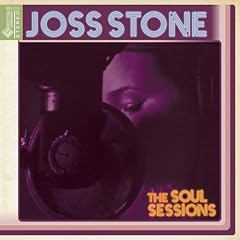
Joss Stone, the Soul Sessions - We find ourselves split. I like this record, but it's a little too much soul for the wife. Anyhow, if you need some groovy yet romantical-type music, this might fit the bill. A good band, great singer, good songs.

-----

Jim Hall & Pat Metheny - Two jazz guitar masters noodle around for an hour or so. Parts of this record are absolutely wonderful; for instance, the vastly different groove on "Summertime" is worth the price of admission. But the improv pieces will have all but the most dedicated jazz fans wincing a little bit. So, if you can get past the flights of fancy, this is a great album.

-----

The Derek Trucks Band, Songlines - I've reviewed this before (scroll down a bit), but I'm simply astounded that you haven't bought it yet. Really. What are you waiting for? It's one of the best albums I've bought in years.

14 June 2006

Links

New poet laureate, Donald Hall.

-----

I'm trying out del.icio.us. Here are my links so far.

-----

Very good comments about federal vision theology, from a book review of Guy Waters' The Federal Vision and Covenant Theology by David Calhoun.

-----

9Marks, a ministry of Mark Devers. Great interviews & articles!

13 June 2006

Your Elders

Last Saturday morning, I began a six (or seven) week program to train the men of the church plant in being an elder. The idea isn't that each man would be an elder immediately, but that (1) some would be prepared for that work when the church is established, (2) the rest would know what an elder looks like and does in order to vote well and (3) that all the men of our church would be well-prepared in leading their families, since much of that work is similar to the work of an elder.

On Saturday we studied the lists of qualifications for the elders. While we were all sufficiently humbled by these lists, we were also encouraged by these two quotes from the church's past:

Regarding what it means to "desire" the position of elder (1 Tim. 3:1), Patrick Fairbairn:

It is not merely a post of honour, or a position of influence; not that primarily at least, or in its more direct aspect, but a work of active service, and one that from its very nature brings one into living fellowship with the pure and good. The seeking here intended, therefore, after such an office, must be of the proper kind, not the prompting of a carnal ambition, but the aspiration of a heart which has itself experienced the grace of God, and which longs to see others coming to participate in the heavenly gift.

Regarding what it means for elders to be blameless (1 Tim. 3:2), John Calvin:

He wishes a bishop to be blameless…that he must not be marked by any infamy that would lessen his authority. There will be no one found among men that is free from every vice; but it is one thing to be blemished with ordinary vices, which do not hurt the reputation, because they are found in men of the highest excellence, and another thing to have a disgraceful name, or to be stained with any baseness. In order, therefore, that a bishop may not be without authority, he enjoins that there shall be made a selection of one who has a good and honorable reputation, and not chargeable with any remarkable vice. Besides, he does not merely lay down a rule for Timothy what sort of person he must select, but likewise reminds every one of those who aspire to that rank, to institute a careful examination of himself and of his life.

So, if in my last post I could be so bold as to ask you to pray for your preachers, may I now ask you to pray for your elders; pray that their desire would be for God's glory and your good. Pray that they would indeed be blameless, that God would keep them from such sins that would lessen their authority and ability to guide you in His grace.


09 June 2006

Praying for preachers

I hope you pray for your preacher, for insight and faithfulness and conviction and power. My short time preaching has brought me this conviction, that there is nothing more profitable in the preparation of a sermon than prayer, both my own and the prayers of others.

Here's a great preacher's prayer from The Valley of Vision, a collection of Puritan prayers:

My Master God,

I am desired to preach today, but go weak and needy to my task;

Yet I long that people might be edified with divine truth,
that an honest testimony might be born for You;

Give me assistance in preaching and prayer,
with heart uplifted for grace and unction.

Present to my view things pertinent to my subject,

with fullness of matter and clarity of thought,
proper expressions, fluency, fervency, a feeling sense of the things I preach,
and grace to apply them to men's consciences.

Keep me conscious all the while of my defects,

and let me not gloat in pride over my performance.

Help me to offer a testimony for You,

and to leave sinners inexcusable in neglecting Your mercy.

Give me freedom to open the sorrows of Your people,

and to set before them comforting considerations.

Attend with power the truth preached,

and awaken the attention of my slothful audience.

May they people be refreshed, melted, convicted, comforted,

and help me to use the strongest arguments drawn from Christ's incarnation and sufferings,
that men might be made holy.

I myself need Your support, comfort, strength, holiness,
that I might be a pure channel of Your grace,
and be able to do something for You;

Give me then refreshment among Your people,

and help me not to treat excellent matter in a defective way,
or bear a broken testimony to so worthy a REdeemer,
or be harsh in treating of Christ's death, its design and end, from lack of warmth and fervency.

And keep me in tune with You as I do this work.

07 June 2006

A Quick Stop

Go to Greg Wilbur's blog and scroll down till you get to "Why I Like Catholic Authors." What a great post! It's a strong indictment of the reformed world; that those with a reformed worldview spend so much time debating that worldview instead of using it is a shame of the highest order. And so we're left with "evangelical" fiction. Young people: take up the charge. If you can write, don't stop! If you have your worldview down pat, take it off the shelf and put it to good use. Write, sing, sculpt, paint!

06 June 2006

Psalm 22:11-20

Theme The suffering and humiliation of Christ for you.

Notes Few psalms speak so clearly of – and draw us so immediately to – Jesus Christ. The focus of this twenty-second Psalm is not necessarily the intricacies of the prophecies and their fulfillment, but the humility and humiliation of the Lord’s suffering servant. How is it that the King could ever suffer so much rejection and pain? More to the point of this song, how would the King deal with such rejection?

This song’s glory is that it remains a clear, direct window in the heart of our Savior on the cross. It’s a powerful song through which we come to know more deeply our precious Savior – not just to know of him, but to know him! And in knowing him, we can come to rejoice in our union with him all the more. In this section of the song, we see:

· Jesus’ cry for the Father’s presence (11), being truly in a position where no earthly help was available.

· Jesus’ awareness of his enemies, the “bulls of Bashan”(12-13 – the biggest, strongest bulls in the country), those who sought to devour him.

· Jesus’ assessment of his heart-condition (14-15), that hope was gone and despair had begun its reign for the coming of the dust of death.

· Jesus’ assessment of his outward condition (16-18). These verses chronicle the realities of his crucifixion: surrounded by evildoers (Mt. 27:27-31), pierced hands and feet, clothing dispersed by gambling (Mt. 27:35), and the gloating of all those who thought they had won.

· Jesus’ second cry for the Father’s deliverance (19-20); even though he had been rejected by the Father, our Savior yet had the faith to believe that his Father would never abandon him to the grave (Acts 2:27). Committing his soul into the Father’s hands, Jesus submitted to the final, utmost cruelty sin has ever imposed: the death of the Son of God.

What are we to do with this song? Should not our hearts overflow with thanksgiving and wonder as we meditate on the suffering of Christ for us? Shouldn’t we be encouraged beyond description by this most vivid example of God’s love for us?

We can also see in this song from what Christ saved us; here in his despair is a perfect picture of hell, the just rewards of our own sin. Here is where we would be if the perfect sacrifice had not filled our place. So, for the heart of the Savior revealed and for the wonder of salvation made new again, this is one of our greatest songs of worship!

Eternal Perspective

It's humorous more than anything, right? The number of the beast has finally shown up on our calendars (6/6/6 - "Tuesday, Tuesday, Tuesday!! Get your beast on!"). Among other headlines:

  • Party in Hell. Hell, Michigan, is doing its best to capitalize on American evangelical superstition. (Justin, are you going? If so, pick me up one of the official titles to "1 square inch of Hell.")
  • Tim Lahaye's newest end-times histrionics is arriving.
  • The remake of Omen, the movie, is opening today.

And, oh yeah, the Lord's compassions are new this morning.

Pastor Long preached a powerful sermon on death Sunday morning. Part of the spirit of the Lazarus story is that, despite the real pain of what may come, Christ is over all for the church. It's a matter of heavenly, eternal perspective that ought to keep us in the right state of mind. Then Sunday night I preached on Proverbs 28, the first verse of which states unequivocally, "The righteous are as bold as a lion." Boldness, confidence, certainty. These are Biblical adjectives of Christ's church in relationship to the world.

While God's Word gives us no wiggle room in realizing that hard times may and will come, what is the foundational attitude the church is to have regarding this life, this world? Confidence! In ourselves? No. In our nation? Nope. In the progress of humanity? Nada. In the promises of Christ to build His church and include us in that great work? Absolutely!

To be clear, there are things to fear: we have an enemy far more powerful than us (though not more powerful than our King). But as long as our fear of evil drives us to Christ, as long as we believe Jesus when He speaks about His kingdom, the basis of our mission to this world is confidence. Whatever reasons lay behind American evangelicalism's culture of fear, it needs to be put in the grave. The slight broo-ha-ha of 6/6/06 is a reminder that the church's zeitgeist is to be blown and tossed by the wind by every wind of doctrine or hint of scandal.

When we live in confidence in the gospel, things will change. We will make decisions about our kids' schooling based on Christ's kingdom, not based on fear of what the public schools can do to our kids. We will be more evangelistic, believing that we lay hold to the very power of God for salvation for all who believe! We will view worship as a wonderful foretaste of heaven, not a life-preserving icebox of the soon-to-be raptured. And we will love our city. We will care for the environment. ...and so on.

Let's put away fear that denies the gospel promises of Christ. Let us, by the Spirit of power and love, put on confidence and boldness like a lion.

05 June 2006

Just because I can

John Coltrane and Miles Davis. Gather the kids around the computer and teach them about jazz!

02 June 2006

Our Australians and My New Officemate

Our Australians left yesterday on their circuitous route back to the down under. They lived and ministered with us for almost 10 months. What a great and blessed time! It was truly sad to say goodbye to them, especially considering some of those who've come to love them may very well never see them again this side of heaven. But it's good that we serve the same King and can entrust them to His care and the ministry of His kingdom.

So, for any blokes and sheilas out there in internet-land, take good care of them!

-----

I'm hunting. More precisely, I'm trapping.

There's a mouse in my office and he isn't letting me get much work done. He'll be gone soon.

-----
We're headed camping this weekend; Lord willing, we'll see you on the flip side.

31 May 2006

Positively Speaking

The last post focused on one possible way to get off-track in our thinking about worship. That is, using worship is a tool to attract unbelievers to Christ sure sounds nice, but ultimately detracts from the greatness of what worship really is: God's covenant people drawing near to Him through Christ in order to raise their voices to Him and be made new in the image of their Savior. As always, more and Biblical thinking on worship will save the church from many pitfalls.

Beyond this, though, my mom spurred me on to think more of the lessons we could learn from the "church growth" corner of the American church. To me, the clearest lesson is the great sense of mission these churches have. If their mistake is making this mission the primary purpose of worship, my mistake might very well be not considering the full extent of the Great Commission. Though we need to reject some of our brothers' methodologies, certainly much work remains for the reformed church to continue thinking Biblically about our outward mission.

Thus a new question for discussion: if our commission shouldn't look like that (see below), what is it to look like?

A first part of the answer might be that our mission ought to look like church planting, not just individual evangelism. How better to follow the Apostle Paul than to see the work of church planting as vital and necessary part of being a church than a side-effort we may or may not engage in, depending on our resources? Toward this, check on Tim Keller's great article: Why Plant Churches?

Go to church & get gas

Thanks to Aunt Sarah, who sent me an article about a church in Arizona offering free gas cards to new members and visitors. Why? To remove a possible excuse for going to church, of course! What happens when your church is so focused on visitors and growth? Your focus becomes your marketing strategy, which this church has in spades.

Putting aside the sarcasm for a moment, this is really, really sad. These people are believers; they love Jesus, they have believed on him for salvation. But they're getting important parts of the church wrong. Lest we put overdue focus on the first church of gas, this is a phenomena that spans our country. Their love for the lost is commendable, and ought to rebuke many of us. But the church doesn't exist for the lost; it exists for our bridegroom. It doesn't exist by our worldly wisdom; it exists by our King's power. What a drastic compromise we have made with the world.

I guess what put me over the edge on this one was this particular church's emphasis on creating a brand. From their website: At The XXXXX, we will create a brand... We desire to be the first “Brand” of church that comes to a non-attender’s mind when thinking of or looking for a church. I would point out here that an emphasis on marketing and "branding" will likely lead to the opposite of their goal: they will turn off those they are trying to reach. This will happen because we've been marketed to our whole life. I don't need another product; I need a church. If you have to sell your church to me, it's a product, not a church. I don't need someone else to pander to me, I need a church that believes God - not me - is the center of life.

Where in Scripture is the purpose of worship to attract - or even minister to - unbelievers? Surely the lost are called to faith by Biblical preaching, but the purpose of worship has never been centered on those outside the covenant. Where in the Bible does God ask us to come up with marketing strategies? How weak is our faith in Christ's promise to build His church that we feel the freedom to push aside the Holy Spirit and buy people into church?

-----
Note: I originally had links in this post to the article and the church's website. I removed them, wanting instead to comment on the problem at-large than simply take pot shots at one church.

30 May 2006

Links

Top ten most expensive things ever purchased on ABEbooks.com. Wow.

Librarything.com - I know I've mentioned this before, but I can't imagine why you wouldn't love this! Catalogue all your books online...find others with your passions in reading...let me see what books you have that I can borrow...Here's my library.

Opentext.org - a fascinating, scholarly work in aiding those who work in Greek, especially New Testament Greek. Not for everyone, sure, but could be quite the service to preachers.

Soldiers from Lafayette (209th quartermaster company) are heading to Iraq again. Leaving on Memorial Day, they spent time remembering Spc. Luke Frist, of Brookston, who was killed by a roadside bomb their first time around in Iraq.

Justice

I'm studying Proverbs 28 the next couple of weeks; since it's a passage focused on justice, I've also undertaken to study the question, "What is justice?" Though I have yet to arrive at a nice, succint definition, Scripture clearly shows that the root of justice is in the character of God (note: not in the "rights" of men). This being the case, a study of justice must begin by meditating on the holy and just character of our God. For this, nothing quite beats reading parts of Stephen Charnock's The Existence and Attributes of God. Here are some great quotes about God's character and its bearing on justice.

Better man should forever bear the punishment of his offence, than God bear the dishonor of his attributes: better man should be miserable than God should be unrighteous, unwise, false, and tamely bear the denial of his sovereignty.

A hatred of unrighteousness, and consequently a will to punish it, is as essential to God as a love of righteousness…he will have an infinite justice to punish whatsoever is against infinite holiness. As he loves everything that is amiable, so he loathes everything that is filthy, and that constantly, without any change; is whole nature is set against it; he abhors nothing but this.

The severeities of God against sin are not vain scare-crows; they have their foundation in the righteousness of his nature; it is because he is a righteous and holy God that he “will not forgive our transgressions and sins”…

God would descend below his own nature, and vilify both his knowledge and his purity, should he accept that for a righteousness and holiness which is not so in itself; and nothing is so, which hath the least stain upon it contrary to the nature of God. The most holy saints in Scripture, upon a prospect of His prutiy, have cast away all confidence in themselves…

25 May 2006

Book Review - New is always better. Right? Right?


Justification and the New Perspectives on Paul
Guy Prentiss Waters
P&R Publishing, 2004

Along with the Federal Vision-ist stuff often comes discussion about the New (!) Perspectives on Paul (NPP). And so the need for a well-researched and thoughtfully written book; Guy Prentiss Waters seems to be the right man for the job. Having all the big letters after his name (MDiv, PHd, etc.), he's also an ordained PCA minister and an assistant professor of Biblical studies at Belhaven College. His qualifications are again boosted by the fact that he studed under E. P. Sanders and Richard B. Hays, two leaders in the NPP movement (the two current big names are N. T. Wright and James Dunn).

What is the NPP, you ask? Reformation21's first issue was on it; therein, Ligon Duncan had these helpful summary comments:


[The NPP] suggests that the Protestant Reformers’ exegesis of Paul on justification and their theological formulations of what Paul taught about our being justified by grace through faith alone, and not by works, based on the work of Christ alone, imputed to us were mistaken. The NPP even questions whether Paul was primarily concerned with the question “how can I be saved?”


How did the Reformers get it so wrong? By focusing on justification and excluding Paul's main concern: Paul wasn't concerned with salvation by grace over/against salvation by merit. He saw contemporary Judaism as a religion of grace, not merit. Therefore, the biggest question of the gospel is "How can a Gentile be saved? How can Italians and Swedes be included in the Jewish covenant people?" (Note: historic reformed exegesis has never thought Judaism was, de facto, a religion of merit. But, we have understood Paul to criticize contemporary Judaism as a malformed religion of merit - Pelagian, if we were to import a good theological term.)

Waters does a great job tracing the roots of the NPP. The roots of this movement lie squarely in the historical-critical tradition of German scholarship - historically unfriendly ground for those who believed the Bible was, well, the Bible. He does a good job showing the sometimes vast distinctions between these scholars, as well as the threads that tied them together.

Along came E. P. Sanders, who claimed to have gone back to original sources in Pauline-era Judaism and said he could prove that 1st-century Judaism was not a religion of merit, but grace. While reformed scholars have always placed high value on the historical context of the epistles, Sanders' move is one to watch out for: placing historical study above what the text actually says. In essence, NPP says, "Because we know the Judaism Paul grew up in was a religion of grace, he couldn't have been saying what everyone always thought he was saying." When you take that mindset into Scripture, you're always going to find evidence to back up your claim.

And while each of these scholars disagree at points (especially in their approach to Scripture: Ephesians, Titus and 1-2 Timothy are generally thought to be "post-Pauline"), Waters points out these main theological errors, which are built on his discussion of NPP scholarly errors:

  • Confusion of legalism, grace and merit
  • Ignoring the doctrine of imputation - this is perhaps the most dangerous part of the NPP. The ignoring - or outright denial - of the doctrine of double imputation is disastrous for Christians. This doctrine states that, by grace through faith, Christ's righteousness is imputed to me and my sins are imputed to Him. Thus I am and ever shall be, both justified and adopted, declared innocent and declared family. For more on this, see John Piper's Counted Righteous in Christ. By denying this, the NPP takes away what the protestant world has always looked to for assurance of salvation.
  • Upsetting the balance between forensic and transforming grace. Reformation scholarship helped us to see grace's effects as both forensic (guaranteeting us a "not-guilty" verdict in God's courtroom) and transforming (making us more like Christ). Wright says that the believer's final acceptance, rather than the righteousness of Christ imputed to him, "is his covenantal faithfulness."
  • Redefining justification - The NPP has recast justification as an ecclesiological (church) issue rather than a soteriological (salvation) issue. Being justified, to the NPP, is being part of the church, being part of the covenant community. While reformers have always rejoiced in being counted one of God's people, being "united with the Jews on equal terms" (Martin Luther), this cannot be the exclusive heart of justification.

Waters finishes the book by considering "what's at stake for reformed Christianity?" In this section, he addresses the main things we have to lose should NPP take the day (our view of Scripture, why Christ came to die, the role of baptism, the doctrine of regeneration, etc.), shows some ties between NPP and the Federal Vision folks as well as Norman Shepherd. (I was struck several times with the thought, "Boy, this sure sounds like something the FV guys would like." Especially in a great emphasis on covenant-keeping and the power of the sacraments.)

Overall, this is a good book that clearly has a lot of study and thought behind it. Waters does a good job critiquing the NPP and I leave the book feeling that I don't really need to keep reading on the subject; my NPP cup is full. Should you buy it? Probably not. Unless you're a pastor or someone responsible for the souls of many others, it's probably just trivia (and fairly dry trivia) to you. But if this is a skirmish you need to fight, Waters' book fits the bill.

23 May 2006

Ball 1, Jared 0...or Why the Last Post was an Inadvertent Lie

Sunday night I preached on The Lord's Goodness from Psalm 31. Somewhere in that sermon, I reminded God's people that He simply cannot be better to us than He already is at any single moment. Whatever happens, I said, this is God's goodness to you.

Last night, God's goodness came to me in the form of a softball to the nose. I was playing right field and ran up to catch a line drive. My glove miraculously shortened and I was left to catch the ball square on the nose. Blood ensued.

They ended up calling the 'bambalance after I passed out, so I then got my first ride in an ambulance. At the emergency room, I fainted again during my x-rays. Turns out there's a small break toward the bottom of my nose near the lip, but not bad enough to set.

And today, rather than in Pennsylvania listening to preaching, I'm at home with my family and an extremely swollen face. I thought about posting some pictures - too bad we didn't get one at the ballpark, I hear I was quite the mess - but I want you all to still like me when I'm better. For now, I'm working on jello and smoothies, since my teeth aren't functioning properly just yet. I have an appointment with an ENT this week to see how bad my face is (insert favorite pun here).

Although several have already said it, God was good to me. It could have been worse (of course, the skeptic in me wants to say it certainly could have been better, too). And I'm not in as much pain as they said I would have.

I hope your week started less eventfully than mine. I've got some book reports to post soon. See you then.

...And we lost. Bad. Alas, I think my bloodiness disheartened the team. Or made them laugh too hard to play well.

22 May 2006

This Week

I'm heading out tomorrow morning for the Banner of Truth Pastors' Conference in Grantham, PA. It should be a fun and encouraging time; the speakers are Sinclair Ferguson, Joel Beeke, Phil Ryken, Ian Hamilton, Mark Johnston and Matt Kingswood (Matt is an RPCNA pastor in Russell, Ontario).

Lord willing, I'll write some about it this coming weekend. Have a great week!

18 May 2006

Is Smaller Better?

It seems it's populer these days to decry the blight of urban sprawl, that seemingly-inexorable move of the middle- to upper-middle class away from urban centers to outside the city, to "suburbia." I find myself torn somewhat. I like the ideals of stewardship and community that drive those who like city living; I also identify with those who wish to raise their family in safety and comfort.

A couple recent stories from npr brought this to mind, again:

This one details "tiny house" companies and owners. These are houses as small as 70 square feet (!), their benefits being a smaller ecological footprint, a focus on quality over quantity, and the ability to live, well, wherever you want.

This story is from an author who's arguing that urban sprawl isn't the new Satan many make it out to be.

As a family, we've committed to living where people are, not necessarily where we'll be the most comfortable. This is not to denigrate comfort, but to put it in perspective; we're not here for comfort, but to fulfill a mission. We're here to glorify God - part of which is bringing others to glorify Him as well.

Additionally, I'm attracted to the ideal of quality over quantity, of living better rather than bigger. As long as I have enough bookshelves...

So, urban sprawl vs. city-living - what do you think?

17 May 2006

Believing the Gospel

In our core group for church planting, we've generally gone about our studies by trying to answer these questions (and in this order):

Why plant a church?
Why plant a presbyterian church?
Why plant a reformed church?
And, finally, why plant a reformed presbyterian church?

So, we're concluding by focusing on our distinctives, those things that set us apart. This week and next, we're studying the issue of musical instruments in worship. Again we find ourselves squarely in line with church history but way outside the current practice. After I present the material to the group, I'll post a little more, but here's a great quote from John Calvin that gets to the heart of this issue: Is Jesus Christ our perfect sacrifice or not?


A difference is to be observed in this respect between his people under the Old and under the New Testament; for now that Christ has appeared, and the Church has reached full age, it were only to bury the light of the Gospel, should we introduce the shadows of a departed dispensation. From this, it appears that the Papists…in employing instrumental music, cannot be said so much to imitate the practice of God’s ancient people, as to ape it in a senseless and absurd manner, exhibiting a silly delight in that worship of the Old Testament, which was figurative, and terminated with the Gospel.
–Commentary on Psalm 92, pg. 495

12 May 2006

Oh, if it were true

Perhaps you, like me, get spam. Not the wonderful nearly-meat product, but emails tailored to annoy you and consume your inbox. But perhaps you don't get the same type of spam as I do. Somehow, I now get "pastor" spam. They know where I am and what I do, so I regularly get emails with subject headings like: SEED OF FAITH! Dear Beloved in Christ... and so on. These emails are usually (1) from someone in Africa, because, hey, who doesn't like Africa? and (2) promise amazing amounts of reward if I would simply send them my bank information (yeah, it's on its way).


If these emails were true...

  • I could get $5.6 million from Janet Hamson in Kuwait, whose husband left her this money. Now she's dying of strokes (poor Janet). She really wants to give this money to someone who will use it for orphanages and widows and nice fluffy things like that.
  • If I would only contact Mr. Uba Ego in Paraguay, he will send me $800,000! What, oh what, am I waiting for?
  • Barrister Greg Mba (what's a barrister?) is ready to make me next of kin to the unforunately deceased German Andreas Schranner. Although he doesn't say how much, this involves a "huge sum of money to" my corporation. You know, the Jared corporation.
  • Poor Mrs. Jane Fowler of Dublin had her whole family die. Luckily (?) they left her $10 mil. Although I can't get the whole thing (she wants 6 million to go to "ministry"), if I give her my info, she'd set me with a cool three million for my efforts. Boy, it's a good thing she got saved and is ready to be so generous to complete strangers in Indiana - it's part of her revelation from God. She doesn't even know if I like Dublin or not.
  • I've won the Euro Lotto sweepstakes! I get 12 million Euros (is that a lot?). Somebody in London really likes me.
  • Mr. Sunny James, from Nigeria, is representing the late Mr. Henry and Doris Williams. Their earnings totaled $25 million, which is all sealed in a trunk somewhere in Europe just waiting for me (and my ministry). How cool that God led Sunny to find me on the internet after he was finished with his "fasting and prayers."
  • Maxwell in London has less than 18 months to live and wants to give $20k to our ministry. Sorry, Maxwell, but this just doesn't stack up to the $25 million I've got waiting for me somewhere in Europe.
  • Finally, can you find it in your heart to help Kebi Moyle, a Lebanese who's now in Ghana, hoping to come to America? See, he's got a lot of money to buy a house with, but wants you to keep it for him until he gets here. Boy, he trusts you more than I do.
So, if only this were true, our church would have roughly 60 million dollars to do "ministry." I guess we'll just have to stick with the Holy Spirit.

09 May 2006

Turning Blogs Inside Out

Alan Jacobs had an interesting article in the most recent Books & Culture about blogging. It was very well written and even-handed. His main point was that blogging is pretty cool, but has its downsides. It is good for information purposes: news, news-checking, updates on subjects of interest, etc. But it's not so good for conversations. He argues that the architecture of a blog prohibits really valuable conversations from taking place. Other than the inherent roadblocks of an inhuman interface, the blog world seems to be one where one must, like university professors, publish or die.

Discussing this with my wife, especially concerning the propriety of this here blog, she made the comment that this blog does seem to generate good conversation, just not on the internet. With relative frequency, people will strike up face-to-face conversations about something I've written on the blog. This is partly possible because I believe I know personally most of the people who read this blog (and would really like to meet the rest of you). This is, in my opinion, the answer to Mr. Jacobs' valid argument: if the thoughts and conversations on blogs, and cyberspace in general, remain there, it's likely that little has really been accomplished. But if we can take from there thoughtful comments and bring them to our face-to-face conversations, it would seem we've found a useful tool. This way, blogs become matches rather than the whole fire.

This clarifies the "user instructions" for this blog: it is far better to take material from here and use it to light real conversations than simply to engage in polemical "commenting" ad infinitum. Though I do love a good comment now and then.

-----

Please read this by George Grant. I'm done being nice in my sermons. :)

Please read this by Barry York.


04 May 2006

Links

Pictures from Cush4Christ, RPCNA mission work to Sudan.

Moussaoui is spared the death penalty, America is proven the fool. Peggy Noonan's devastating and thoughtful response.

Ouch. Whatever happened to the Protestant work ethic (thanks David, for the link).

New issue out from Reformation21.

Blogs from friends smarter, and thus funnier, than I: Elizabeth and Meg, our Sunday night companions.

03 May 2006

Deep Waters

A few posts back we were talking about how we test candidates for the ministry in regards to their theology. One of the commentors asked me to make some comments on the Federal Vision theology. The title for this post reflects my feelings about this task.

Comments on the task:
  • If you don't know what the Federal Vision/Auburn Avenue theology is, please don't feel the need to go find out (Pro. 26:17). Don't interpret this post as "Jared really wants all of us to investigate this to the nth degree."
  • Although I've done some reading on the Federal Vision and listened to some of the tapes, I am by no means highly qualified to speak on the subject (which is why I'll mostly quote those who are). Having said that, though, I am charged by God to "insist on" the doctrines of grace (Titus 3:8) and be part of the watchmen for the city of God. The Westminster divines cautioned pastors against bringing up doctrinal controversies just for the sake of controversy. That is, only when the need is real should we take up the debate publicly. I'm still not yet convinced that time has fully arrived in our circles. But as some of you are thinking and asking questions, I feel it would be unfaithful to not answer.
  • Another part of my hesitancy to enter into this topic is that I have purposed with this forum to be encouraging and instructive, but not predominantly polemical. I don't want this to become the page where people go to see a good argument. So, hopefully, this page won't become a place where I take potshots at everybody who makes me itch.

Initial comments on Federal Vision-ism:

  • Names to know: Doug Wilson, Doug Jones, Steve Schlissel, John Barach, Steve Wilkins, Peter Leithart. To be fair, these men cannot be counted as one, consistent group. Within the FV group, there are significant disagreements over specific issues, such as paedocommunion. Also, my disagreements should be seen as intrafamilial discourse; that is, when we debate FVists, we're sitting around the table with family, not taking up the sword against enemies. History to know: this mostly exploded at the Auburn Avenue Pastor's Conference in 2002, followed up by the 2003 conference which was structured in a debate format.
  • As I've read and listened to FV materials, I am struck with how much difficulty I've had in simply understanding what they're saying. Over and over again, they've claimed that they haven't received a fair and thorough hearing in the reformed community. This may be true, at least partially. It's also probably true that I'm not quite theologically inclined or informed enough to do their nuanced positions complete justice. But certainly some of the fault lies with FV proponents and their methods of communication. Sometimes I'll wonder if there's any problem at all, other times my forehead will be sore from me slapping it so much in disbelief. Whether my fault or theirs or both, simply the style of writing and discourse makes comprehension fairly difficult.
  • There are parts of FV that have been helpful in my thinking and preaching. One of their major points is the objectivity of the covenant, that when a baby is baptized, he/she is a member of the church. The church and the family is to treat them as such. Our children are not in and of the world, but in and of the church. A little meditation on that idea makes quite a difference in how we treat our kids, in and out of worship.
  • This covenantal objectivity, though, is also at the heart of the disagreements. For FV, the covenant is the thing; we reformed people have been too introspective and too concerned with God's secret decrees for far too long. We need to (they claim) focus on the tangibles (baptism) and not the intangibles (election) when it comes to assurance of salvation.
  • From Pastor David Reese in the RP Witness article "The Reformation's Midlife Crisis" -
    The Federal Visionists want to de-subjectivize the Christian life and save us all from being overly concerned with our personal standing before God. The covenant is objective and is all we can know about ourselves and others in the here and now. Baptism is the mark of the covenant, and therefore baptism is the objective mark of salvation. But since a baptized member of the covenant can apostatize and go to hell, the FV thesis actually provides no assurance for baptized members. The Reformed doctrine of justification by faith alone puts the gospel before a person to be believed upon for assurance (WCF, 18). The FVs put assurance upon the shaky ground of a person's persevering performance in the covenant.

Please ask questions for clarification; again, if you haven't heard of this or don't much care, that's fine. Really. But if you're working through it, let me know what's sticking in your craw. Much more could be said and I'll try to post a few more interactions with FV theology on more specific aspects.

02 May 2006

Music

Bela Fleck and the Flecktones live. Anyone who can make the banjo cool is, um, cool. And Victor Wooten playing bass is more fun than two, even three, barrels of monkeys. You'd have to be silly not to listen (or maybe just busy).

Speaking of banjos, I've been listening to Alison Brown, a great banjoess. On Stolen Moments, she's not quite as out-there as the Fleckster, but she brings a nice jazz sensibility to the songs. My favorite is her cover of Simon & Garfunkel's "Homeward Bound" with the Indigo Girls.

-----

I received a subscription to Paste magazine for Christmas. It comes with handy-dandy CDs which are, in and of themselves, really good listening. Last month had a song by the band Robinella called "Break it Down." It was like Norah Jones and Nickel Creek had a musical marriage. Bluegrass/roots music sung by a jazz lady. So we got the cd, Solace for the Lonely, and we both dig it. It's pretty laid back, with a focus more on the singing of Robinella Cantreras than the more-than-capable instrumentation by her husband, Cruz, and the rest of the band. The songs have a good sense of humor as well as a subtle, gospel-influenced, Biblical worldview. Try it; you'll like it.

-----

Throwback: James Hunter, a new-to-America soul singer from England. A little too much fun for my office in the basement, but we're getting there.

01 May 2006

Austen City Limits

Providence has conspired to bring me into closer contact with Jane Austen than has previously been the case. This is okay, as it gives me something to write here about.

First, thoughts I had which I either did or did not express out loud whilst watching the newest Pride and Prejudice (I will admit, with only a little embarassment, that I sorta teared up during Mr. Bennett's talk with his daughter Elizabeth: "I didn't think anyone could ever deserve you."):

  • Now I don't have to read the book.
  • We're never having any more daughters. Only sons. And rich sons.
  • Wow, that was good [upon Mr. Darcy's "bewitched, body and soul" speech]
  • These people need jobs. Seriously, if they had good stuff to do, they wouldn't be as worried about balls and rich aunts and matchmaking.
Second, a passage from Mansfield Park about preachers: [from Miss Crawford] Oh, no doubt he [a potential pastor] is very sincere in preferring an income ready made, to the trouble of working for one; and has the best intentions of doing nothing at all the rest of his days but eat, drink, and grow fat. It is an indolence, Mr. Bertram, indeed - indolence and love of ease - a want of all laudable ambition, of taste for good company, or of inclination to take the trouble of being agreeable, which make men clergymen. A clergymen has nothing to do but to be slovenly and selfish - read the newspaper, watch the weather, and quarrel with his wife. His curate does all the work, and the business of his own life is to dine.

Well, there it is, the business of my life is to dine. I'm going to McDonald's.

28 April 2006

Quotes

In our church planting core group, we've finally gotten around to studying exclusive Psalmody. One of the objections I've heard to exclusive psalmody is that we're missing out on the great hymns of the church. Regarding that, here are some quotes culled from Michael Bushell's Songs of Zion:

I believe that a man can find nothing more glorious than these Psalms; for they embrace the whole life of man, the affections of his mind, and the motions of his soul. To praise and glorify God, he can select a psalm suited to every occasion, and thus will find that they were written for him.

-Athanasius (296-373 a.d.)

The truth is, the Old Testament Psalms are perfectly suitable to our dispensation. God and His perfections are the same—correspondence with which there is a permanence n the character and the attributes of the saint, which lays a foundation for a stated system of Psalmody; the graces and exercises of the saint are substantially the same at all times; the description and expression of these, by the Spirit of God, we prefer to the paintings of men. If unsuitable, what a pity that neither Jesus nor His apostles, at any time, gave the most distant hint of this fact; nor did they, so far as we know, attempt to supply the defect.

-Gilbert M’Master, An Apology for the Book of Psalms, 1852

27 April 2006

Ridiculous

Why do we fall back into the same sins? How is it, once we've felt their sting, seen their ridiculousness, experienced the carnage, etc. - how is it that we are yet tempted? Are we that spiritually stupid? Sometimes, yeah.

Pro. 26:11 - Like a dog that returns to his vomit is a fool who repeats his folly.

Ah...the favorite verse of little boys everywhere. I clearly remember acting out this verse in junior high Bible class. I gave an inspired performance as "the dog." And yet behind the exceeding grossness of the metaphor lies the exceeding ridiculousness of repeated sin.

When it comes to sin, without God's Spirit and Word and sanctificaiton, I am clearly no better than the dog who stupidly yet happily returns to eat up that which he just ralphed. So as for me there's no way to imagine regurgitated vomit to be appetizing, God must look at my repeated sin with the same disgust and forehead slapping: "I can't believe he's gonna do it again!"

How depressing the whole thing would be if I hadn't been made something new, something un-dog-like, by the work of Christ and His Spirit. Wretched man that I am! Who will deliver me from this body of death? Thanks be to God through Jesus Christ our Lord!

-----

How is my writing? How is your writing? Wired.com on blogging and the demise of the English language. Looks like it's time to go back to English grammar flashcards. Seriously, though, communication in an electronic format need not be sloppy. Capitalize the beginnings of sentences. Write whole sentences. Spell things correctly. 'n stuf

25 April 2006

Book Review - Turning Points

Turning Points, by Mark Noll

Mark Noll is currently the Carolyn and Fred McManis Professor of Christian Thought at Wheaton College, though leaving soon to work at Notre Dame. He's a prolific and well-respected writer, though this is the first book of his I've read (some of you might encounter him in Books & Culture magazine).

The idea behind Turning Points is to organize a survey of church history around 12 major events in post-ascension Christianity. Dr. Noll admits that such an approach has its weaknesses, but argues that an introductory survey like this should find some way of boiling down such a huge topic for dummies like me. (He didn't say I was a dummy.) I must say that the organization of the book was a huge help to me. Here are the 12 "turning points" Noll chose, though he freely admitted others could be added:

1. The Fall of Jerusalem (70)
2. The Council of Nicaea (325)
3. The Council of Chalcedon (451)
4. Benedict's Rule: the Monastics (530)
5. The Coronation of Charlemagne (800)
6. The Great Schism (1054)
7. The Diet of Worms (1521)
8. The English Act of Supremacy (1534)
9. The Founding of the Jesuits (1540)
10. The Conversion of the Wesleys (1738)
11. The French Revolution (1789)
12. The Edinburgh Missionary Conference (245)

Just to cover himself, he added a 13th chapter with "further turning points of the 20th century": the rise of Pentecostalism, the 2nd Vatican Council, the emergence of women in public visibility, the globalization of Christianity as seen through new Bible translations, and the survival of Christianity under communist regimes. Several ot the chapters really filled in huge gaps in my knowledge while others gently challenged assumptions I had made; Noll's fairly sympathetic treatment of the monk's work in the church brought some good balance to my thinking.

This is an excellent introduction to church history. Several times while reading, I found myself wishing I had read this before I took my presbytery exam on church history (not a pretty sight). Very few of us will ever delve deep enough into church history to take up more specific studies of each period or even go to the original sources. So if you need a good guide to church history, let Noll take your hand and walk you through.

Hopefully, you'll read a lot of church history before you get to heaven. Church history gives us desperately needed perspective, hope from God's fulfilled promises, and reliance upon the Spirit in the face of so many errors. ...But if you're going to read just a few church history books, this would be a good one to get.

Turning Points isn't an incredibly easy read, though it's not an academic book by any measure. I could easily envision a high school class using it as a textbook for church history or maybe a fairly devoted Sunday school class.

-----

In other news: turns out that prayer doesn't help you get better. This study found that those who prayed for recovery after a heart bypass surgery fared no better than those who didn't. The sad thing is that some Christians are upset by this because they've so radically misunderstood prayer. (thanks Andy)

-----

Finally: hopefully, #1 will learn to get his "s" and "p" sounds together soon. It's hard not to laugh when he answers "Who is our Helper?" by saying "Holy Ferret!"
The new Sabbath: the Sun-day. School had a day off for nice weather. Can't blame 'em too much...

-----

Sunday's sermon on Proverbs 25 (kinda bad sound this week, sorry).

The answer to the exegetical conundrum (below) is, I believe, that heaping burning coals on our enemies' head is a promise of divine judgment. That is, we are freed to love our enemies by the certainty of God's dealing with their sins and injustices. Rather than simply a symbol of shame, if coals are a sign of justice (as they are in Ps. 140:9,10), then we are freed to love like Jesus loved: without reservation, without vengeance. Finally, to support this idea further, Romans 12:17ff is a passage about not taking vengeance, but leaving vengeance to God; in this context, Paul quotes Pro. 25:21,22, placing it squarely in the realm of vengeance and justice and not just shame.

21 April 2006

Proverbs

This week's fun little exegetical conundrum has come from Proverbs 25:21,22:

21 If your enemy is hungry, give him bread to eat, and if he is thirsty, give him water to drink, 22 for you will heap burning coals on his head, and the LORD will reward you.

The question is: What are these burning coals, what do they symbolize? In his book Crying for Justice, John Day summarizes the three possibilities, to which Charles Bridges add a fourth.

1. Burning coals are a symbol of shame - or -
2. Burning coals are a picture of repentance - or -
3. Burning coals are an image of divine justice - or -
4. Burning coals symbolize the smelting down of the enemy, love that conquers all.

Which do you think works the best? So as not to ruin it for you, I'll let you chew on it; this way, I won't ruin the sermon for you :)

Here's an exegetical help: always check to see if the verse is used elsewhere, whether directly or indirectly.

19 April 2006

Finally!


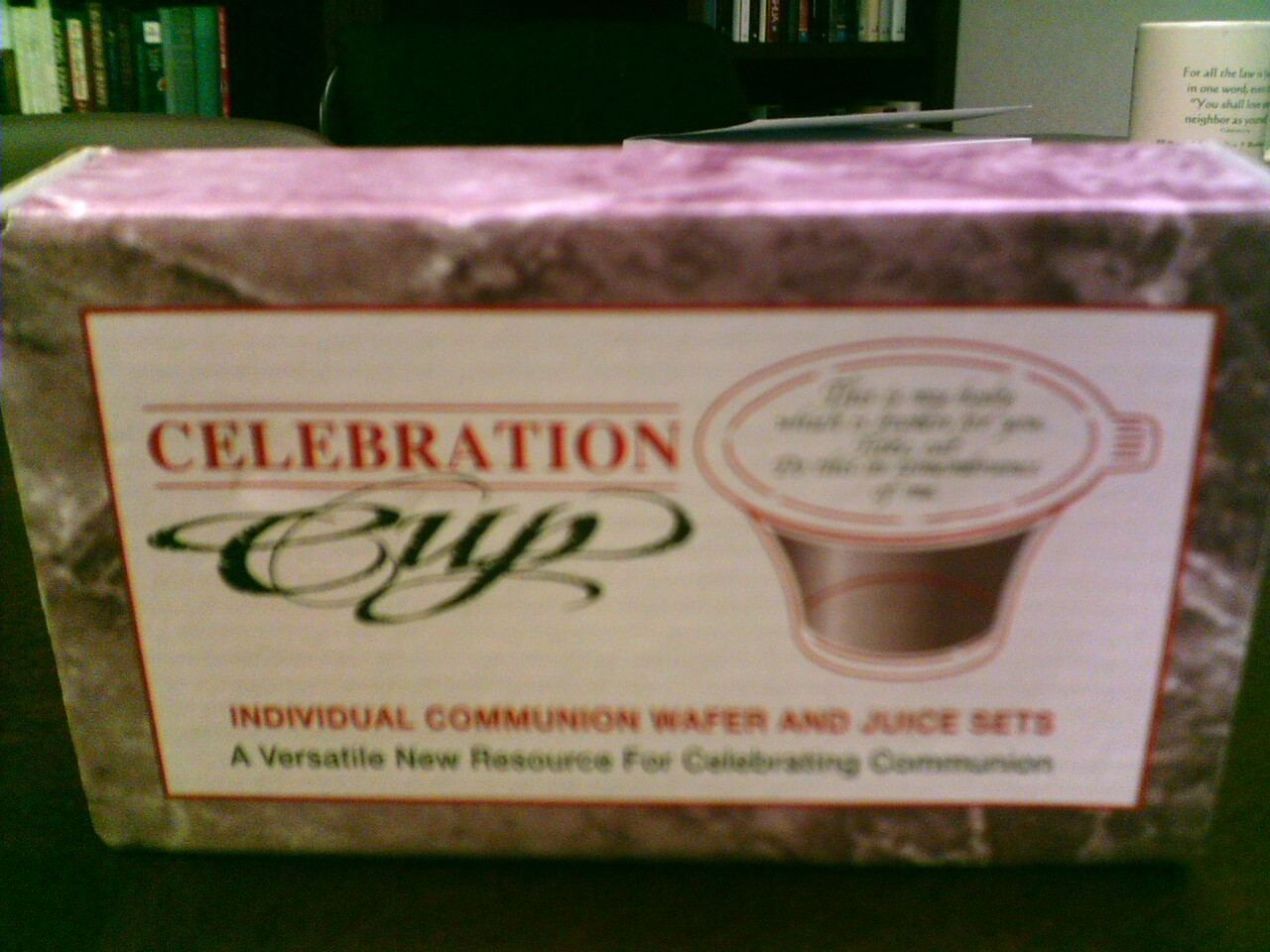
The things we get in the mail...Because preparing for communion was just too much of a burden, now there's the Celebration Cup!, the world's first fully-sealed wafer&wine portable sacramental potable.

The grape juice is all right, but the wafer is powerfully untasty. Oh well, anything in the name of convenience.

18 April 2006

Why so many churches?

This morning I read Mark Noll's chapter on The English Act of Supremacy, wherein Henry VIII and Thomas Cranmer effectively broke England's ties with the Roman Catholic Church and set up the Anglican Church, with Henry as its head. Noll uses this as a jumping off point to think on the historical setting and the result of Protestantism's rise. Here is part of his conclusion:

...it seems to me that the rise of multiple Protestantisms, each tied closely to a local situation, created conditions in which local renewal of the faith could take place more readily and stir hearts more deeply than in the Catholic regions of Eruope. The ecclesiastical division of Europe, however, also hastened the secularization of Europe, because the loss of a universal church directly or indirectly encouraged men and women to disregard all traditional authority and to think and act on their own. Protestantism thus may have created a situation anticipating both the secularization that abandoned Christian authority and genuine Christian revival. By contrast, Roman Catholicism, with its renewed commitment to the universality of the church, probably created a situation less propitious for local Christian renewal, but also more propitious for preserving traditional European respect for religious authority, the revelation from God found in Scripture, and Christian tradition itself.


What do you think? I hesitate to agree that post-Reformation Catholics maintained a high regard for God's revelation in Scripture, but other than that, Noll's assessment helps me understand some of the independent spirit of Protestantism, which so often seems to work against us. The proliferation of Protestant denominations may point to something good (strong convictions), but must also point to something bad, in that disunity always has sin at its root, somewhere. Of course, each denomination thinks that the sin is in the other denomiation and "That's why we had to separate from them." Surely, though, none are 100% correct.

To work toward unity, it helps to recognize where our disunity came from, as best we can.

14 April 2006

Friday's Randomness

I've been feeling fairly dry in blogging inspiration, but it's flowing like a river now, thus the following disjointed post:

Blogs of Irish RP Pastors! (please tell me if names or congregations are incorrect):

Mark Loughridge of Milford RP Church
David McCullough of Dromore RP Church

-----

Good concert: Neko Case at the 9:30 club on NPR.org

-----

Another quote from Noll's Turning Points, this time on the differences between the Greek (Orthodox) and Latin (Roman) church, by Bishop Ware:

From the start Greeks and Latins had each approached the Christian Mystery in their own way. At the risk of some oversimplification, it can be said that the Latin approach was more practical, the Greek more speculative; Latin thought was influenced by juridical ideas, by the concepts of Roman law, while the Greeks understood theology in the context of worship and in the light of the Holy Liturgy. When thinking about the Trinity, Latins started with the unity of the Godhead, Greeks with the threeness of the persons; when reflecting on the Crucifixion, Latins thought primarily of Christ the Victim, Greeks of Christ the Victor; Latins talked more of redemption, Greeks of deification...These two distinctive approaches were not in themselves contradictory; each served to supplement the other, and each had its place in the fullness of Catholic tradition. But now that the two sides were becoming strangers to one another - with no political and little cultural unity, with no common language - there was a danger that each side would follow its own approach in isolation and push it to extremes, forgetting the value in the other point of view.


Nothing like a little theology for Friday afternoon. For you Protestants, which way do you think you/we lean?

-----

A thought on Titus 2 - our Bible study was in Titus 2 last night, which I generally think of as a passage about different roles in the church (older men, older women, etc.). It is indeed that, but I came away profoundly grateful for verses 11-15, which form the theological backdrop for verses 1-10. Often I feel a tendency to approach Paul's teaching on church roles (especially women in the church) defensively, with my gloves up, so to speak. Not that I don't believe him, but I tend to anticipate folks bucking against Paul's instructions for them, especially young women.

But the problem is that I've read it and taught it apart from verses 11-15. A much better way is to meditate on the grace of God (v. 11), our great calling to live heavenly lives on earth (v. 12) and wait actively for Christ (v. 13). This is the Christ who purchased us to Himself by His blood; He didn't purchase a lifeless item, but a people designed to be zealous for good works. What a great calling! This, then, is the foundation of the roles of younger women and men and older women and men: the grace, salvation, and return of Jesus Christ.

-----

Music review:
The Derek Trucks Band, Songlines

I mentioned Derek Trucks a while ago; if you haven't checked him out yet, I pardon you of your minor oversight. Now you have no excuse.

Songlines is flat-out great CD. Derek Trucks, the quite-young guitarist for the Allman Bros., and husband to blues-wiz Susan Tedeschi, is the best slide player I've heard. He clearly has the chops to play faster and fancier than most, but it's his musicality & tastefulness that keep impressing me. Rather than just being a guitar album, songlines is full of great songs and well-placed guitar solos.

For this album, DTB added a new singer, Mike Mattison, whereas in the past they employed guest vocalists. Mattison is a great singer and it helps to have the same voice throughout the album. The rest of the band consists of a drummer, percussionist, bassist, and flute player. The style of music is quite hard to pin down, though Songlines feels less experimentally international than the last two albums.

They cover blues, African, gospel, soul, jazz, etc. It's all very toe-tapping; I often find myself smiling at how good it is. So, if you're looking for a new cd for the summer, here it is.

[p.s. The title of the album comes from aboriginal myths wherein the ancients wandered through the Outback singing creation into existence. Later aborigines believed that if you knew the right songs, you could find your way anywhere. Sort of reminds me of Narnia's creation.]


11 April 2006

Cruce, libro, et atro

No, I'm not learning Latin (unfortunately), but I am reading a good church history book by Mark Nolls titled Turning Points: Decisive Moments in the History of Christianity. This morning I finished a really good chapter on monasticism; it challenged a lot of my assumptions about monks and mendicans, etc. Here's a great quote about monkish evangelism:

The missionary effectiveness of the monks usually depended as much upon their plain virtues as upon more highly visible exertions in preaching or teaching. For a monastery to be established in a pagan area allowed the local population to see the application of Christianity to daily existence, as monks tilled the soil, welcomed visitors, and carried out the offices of study and daily prayer. So arose the saying that the monks civilized Europe cruce, libro, et atro - with cross, book, and plow.


I really like the sound and idea of that. Something to chew on for Tuesday.

07 April 2006

Truth

As I work on this week's sermon about truth and labor, I'm listening to this story on npr.org about Moussaoui's trial. The prosecutors have brought Rudy Guiliani and many other families and witnesses of the 9/11 attacks. The purpose behind these powerful testimonies is to convince the jury that Moussaoui deserves the death penalty for his actions. Biblically, I believe, the answer is "yep."

But two things are bounding around in my head: first, that there has to be such a long, drawn-out trial (beyond establishing guilt) to decide if someone deserves the death penalty, shows that we've got capital punishment all fouled up. These days, to get the death penalty in a federal trial, the crime has to have one or more "aggravations", technical points which make it somehow worse. As if plotting and executing the death of thousands weren't enough.

Second is how poorly npr reported this story. While being quite subtle about it, the flow and phrasing of their reporting clearly favors releasing Moussaoui from the death penalty. Merely judging by the amount of time they give to predicting the defense's options (most likely they'll paint Moussaoui as a victim of bad parents and Islamic extremism), it's clear that their humanism knows no bounds. Now I realize that when I listen to npr, I'm wading into the lion's den as far as truth goes, but this one really took me by surprise. So, here's my word to npr: "Whoever says to the wicked, 'You are in the right,' will be cursed by peoples, abhorred by nations, but those who rebuke the wicked will have delight, and a good blessing will come upon them." (Pro. 24:24,25) Those who report the news take upon themselves a great responsibility to the God of truth, whether or not they acknowledge it.

-----

On a far, far happier note: PBS is airing a 13 week series on the Legends of Jazz, with performances by 13 top jazz folks. Here's an interview with Pat Metheny by USNews.com, partly in reference to the city. Too bad we don't get any television (anybody wanna tape it for me?).

04 April 2006

Book Review - Gilead

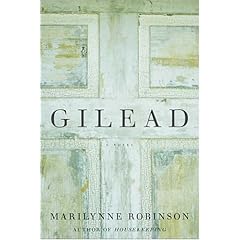
Gilead
By Marilynne Robinson


Congregationalist pastor John Ames has some things to get on paper before he dies in Gilead, Iowa. Having remarried at an older age (after his first wife and child died many years ago), he's concerned that his young son hear the heart of the old man rather than simply remembering an old man who liked to take naps. Gilead is the collection of those writings.

Rare is a book that makes me feel guilty when I read fast, but this is one; it is a book that astounds with the sheer beauty of the written word. It is nowhere complex or pretentious, but everywhere the beauty of grace seems to make the simplest ideas shine. It pleads gently to be read aloud, or at least at a whisper.

There is something of a plot to the book, but it's not important enough to even outline for you. Ames recounts his sons "begats" (his ancestry), his friendship with Boughton, the Presbyterian pastor in town, and does some thinking into Boughton's family. Much more, the book is about the wonder of existence, the nature of love and of the word "good" and the graces of forgiveness and joy.

From the very beginning, I found myself laughing or having to read passages to my wife, notably some good insights on why pastors have so many books. I also found myself just astounded that this wasn't real. Marilynne Robinson won the Pulitzer Prize for fiction in 2005 for this book and deserved every silver stamp she got. There is no Robinson in this book, only an old pastor. It's like those rare experiences when you watch a science fiction movie and realize afterward that you never once doubted that it was all real. Nowhere in this memoir did it seem that someone else other than John Ames was writing. He's a man who's quick to forgive, honest about his own heart, a deep thinker, funny without being capricious, and a man who maintained a bright-eyed wonder at the world.

Sometimes I wish I were a better writer, just so I could somehow convince you all to buy this book. We have such a hard time finding the beauty in this life. Gilead isn't a magic pill toward that end, just a wonderful reminder. Don't read it for precise theology or solutions to philosophical queries. Buy it and read it for the beauty of God reflected in His creation, even in words. I have decided to buy a copy to add to my children's libraries; we especially pray that our daughter(s) will be beautiful women, and Gilead seems to me to be a piece of that beauty.