My heart became hot within me. As I mused, the fire burned; then I spoke with my tongue: "O Lord, make me know my end and what is the measure of my days; let me know how fleeting I am!"

19 April 2006

Finally!


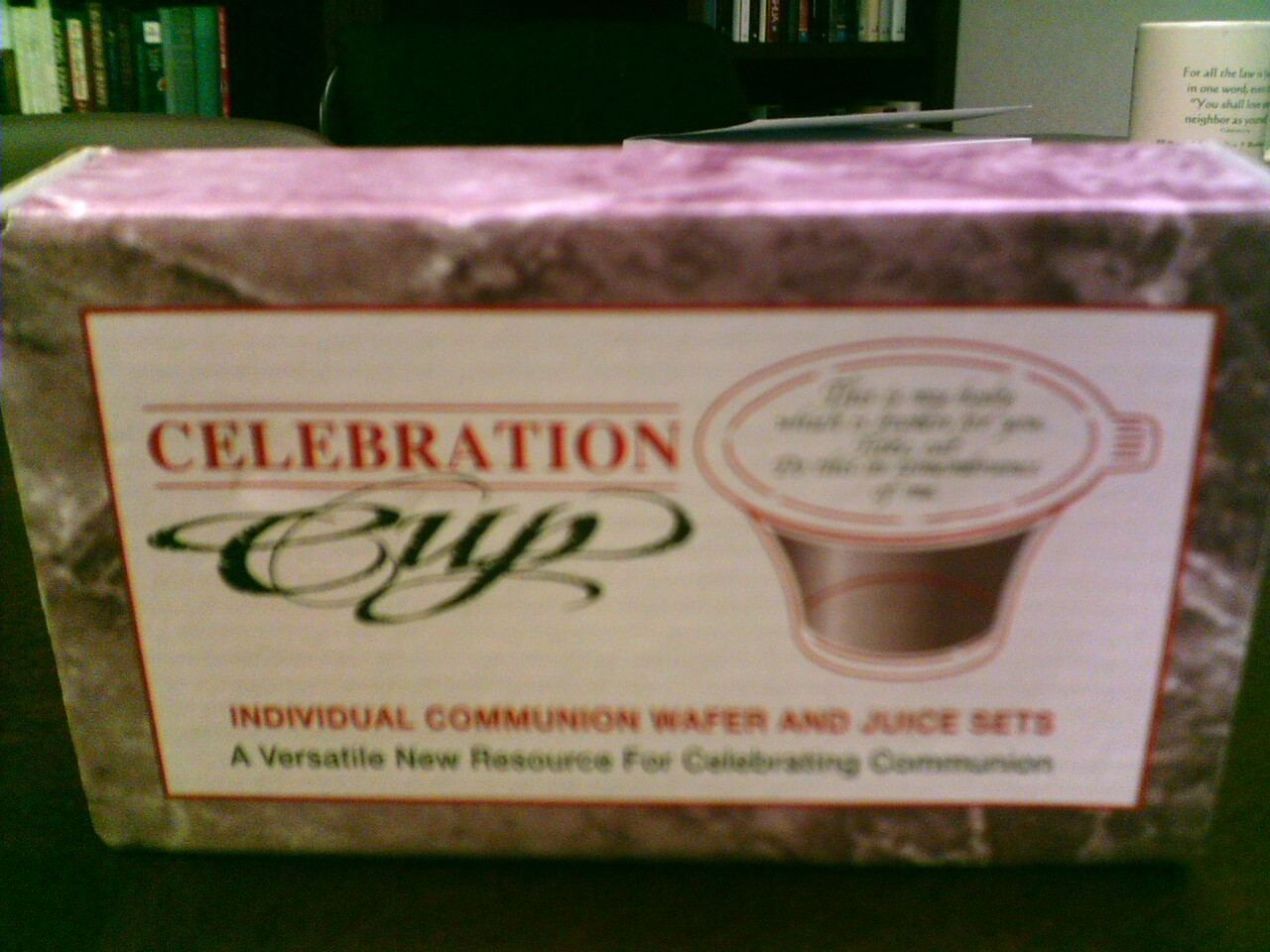
The things we get in the mail...Because preparing for communion was just too much of a burden, now there's the Celebration Cup!, the world's first fully-sealed wafer&wine portable sacramental potable.

The grape juice is all right, but the wafer is powerfully untasty. Oh well, anything in the name of convenience.

18 April 2006

Why so many churches?

This morning I read Mark Noll's chapter on The English Act of Supremacy, wherein Henry VIII and Thomas Cranmer effectively broke England's ties with the Roman Catholic Church and set up the Anglican Church, with Henry as its head. Noll uses this as a jumping off point to think on the historical setting and the result of Protestantism's rise. Here is part of his conclusion:

...it seems to me that the rise of multiple Protestantisms, each tied closely to a local situation, created conditions in which local renewal of the faith could take place more readily and stir hearts more deeply than in the Catholic regions of Eruope. The ecclesiastical division of Europe, however, also hastened the secularization of Europe, because the loss of a universal church directly or indirectly encouraged men and women to disregard all traditional authority and to think and act on their own. Protestantism thus may have created a situation anticipating both the secularization that abandoned Christian authority and genuine Christian revival. By contrast, Roman Catholicism, with its renewed commitment to the universality of the church, probably created a situation less propitious for local Christian renewal, but also more propitious for preserving traditional European respect for religious authority, the revelation from God found in Scripture, and Christian tradition itself.


What do you think? I hesitate to agree that post-Reformation Catholics maintained a high regard for God's revelation in Scripture, but other than that, Noll's assessment helps me understand some of the independent spirit of Protestantism, which so often seems to work against us. The proliferation of Protestant denominations may point to something good (strong convictions), but must also point to something bad, in that disunity always has sin at its root, somewhere. Of course, each denomination thinks that the sin is in the other denomiation and "That's why we had to separate from them." Surely, though, none are 100% correct.

To work toward unity, it helps to recognize where our disunity came from, as best we can.

14 April 2006

Friday's Randomness

I've been feeling fairly dry in blogging inspiration, but it's flowing like a river now, thus the following disjointed post:

Blogs of Irish RP Pastors! (please tell me if names or congregations are incorrect):

Mark Loughridge of Milford RP Church
David McCullough of Dromore RP Church

-----

Good concert: Neko Case at the 9:30 club on NPR.org

-----

Another quote from Noll's Turning Points, this time on the differences between the Greek (Orthodox) and Latin (Roman) church, by Bishop Ware:

From the start Greeks and Latins had each approached the Christian Mystery in their own way. At the risk of some oversimplification, it can be said that the Latin approach was more practical, the Greek more speculative; Latin thought was influenced by juridical ideas, by the concepts of Roman law, while the Greeks understood theology in the context of worship and in the light of the Holy Liturgy. When thinking about the Trinity, Latins started with the unity of the Godhead, Greeks with the threeness of the persons; when reflecting on the Crucifixion, Latins thought primarily of Christ the Victim, Greeks of Christ the Victor; Latins talked more of redemption, Greeks of deification...These two distinctive approaches were not in themselves contradictory; each served to supplement the other, and each had its place in the fullness of Catholic tradition. But now that the two sides were becoming strangers to one another - with no political and little cultural unity, with no common language - there was a danger that each side would follow its own approach in isolation and push it to extremes, forgetting the value in the other point of view.


Nothing like a little theology for Friday afternoon. For you Protestants, which way do you think you/we lean?

-----

A thought on Titus 2 - our Bible study was in Titus 2 last night, which I generally think of as a passage about different roles in the church (older men, older women, etc.). It is indeed that, but I came away profoundly grateful for verses 11-15, which form the theological backdrop for verses 1-10. Often I feel a tendency to approach Paul's teaching on church roles (especially women in the church) defensively, with my gloves up, so to speak. Not that I don't believe him, but I tend to anticipate folks bucking against Paul's instructions for them, especially young women.

But the problem is that I've read it and taught it apart from verses 11-15. A much better way is to meditate on the grace of God (v. 11), our great calling to live heavenly lives on earth (v. 12) and wait actively for Christ (v. 13). This is the Christ who purchased us to Himself by His blood; He didn't purchase a lifeless item, but a people designed to be zealous for good works. What a great calling! This, then, is the foundation of the roles of younger women and men and older women and men: the grace, salvation, and return of Jesus Christ.

-----

Music review:
The Derek Trucks Band, Songlines

I mentioned Derek Trucks a while ago; if you haven't checked him out yet, I pardon you of your minor oversight. Now you have no excuse.

Songlines is flat-out great CD. Derek Trucks, the quite-young guitarist for the Allman Bros., and husband to blues-wiz Susan Tedeschi, is the best slide player I've heard. He clearly has the chops to play faster and fancier than most, but it's his musicality & tastefulness that keep impressing me. Rather than just being a guitar album, songlines is full of great songs and well-placed guitar solos.

For this album, DTB added a new singer, Mike Mattison, whereas in the past they employed guest vocalists. Mattison is a great singer and it helps to have the same voice throughout the album. The rest of the band consists of a drummer, percussionist, bassist, and flute player. The style of music is quite hard to pin down, though Songlines feels less experimentally international than the last two albums.

They cover blues, African, gospel, soul, jazz, etc. It's all very toe-tapping; I often find myself smiling at how good it is. So, if you're looking for a new cd for the summer, here it is.

[p.s. The title of the album comes from aboriginal myths wherein the ancients wandered through the Outback singing creation into existence. Later aborigines believed that if you knew the right songs, you could find your way anywhere. Sort of reminds me of Narnia's creation.]


11 April 2006

Cruce, libro, et atro

No, I'm not learning Latin (unfortunately), but I am reading a good church history book by Mark Nolls titled Turning Points: Decisive Moments in the History of Christianity. This morning I finished a really good chapter on monasticism; it challenged a lot of my assumptions about monks and mendicans, etc. Here's a great quote about monkish evangelism:

The missionary effectiveness of the monks usually depended as much upon their plain virtues as upon more highly visible exertions in preaching or teaching. For a monastery to be established in a pagan area allowed the local population to see the application of Christianity to daily existence, as monks tilled the soil, welcomed visitors, and carried out the offices of study and daily prayer. So arose the saying that the monks civilized Europe cruce, libro, et atro - with cross, book, and plow.


I really like the sound and idea of that. Something to chew on for Tuesday.

07 April 2006

Truth

As I work on this week's sermon about truth and labor, I'm listening to this story on npr.org about Moussaoui's trial. The prosecutors have brought Rudy Guiliani and many other families and witnesses of the 9/11 attacks. The purpose behind these powerful testimonies is to convince the jury that Moussaoui deserves the death penalty for his actions. Biblically, I believe, the answer is "yep."

But two things are bounding around in my head: first, that there has to be such a long, drawn-out trial (beyond establishing guilt) to decide if someone deserves the death penalty, shows that we've got capital punishment all fouled up. These days, to get the death penalty in a federal trial, the crime has to have one or more "aggravations", technical points which make it somehow worse. As if plotting and executing the death of thousands weren't enough.

Second is how poorly npr reported this story. While being quite subtle about it, the flow and phrasing of their reporting clearly favors releasing Moussaoui from the death penalty. Merely judging by the amount of time they give to predicting the defense's options (most likely they'll paint Moussaoui as a victim of bad parents and Islamic extremism), it's clear that their humanism knows no bounds. Now I realize that when I listen to npr, I'm wading into the lion's den as far as truth goes, but this one really took me by surprise. So, here's my word to npr: "Whoever says to the wicked, 'You are in the right,' will be cursed by peoples, abhorred by nations, but those who rebuke the wicked will have delight, and a good blessing will come upon them." (Pro. 24:24,25) Those who report the news take upon themselves a great responsibility to the God of truth, whether or not they acknowledge it.

-----

On a far, far happier note: PBS is airing a 13 week series on the Legends of Jazz, with performances by 13 top jazz folks. Here's an interview with Pat Metheny by USNews.com, partly in reference to the city. Too bad we don't get any television (anybody wanna tape it for me?).

04 April 2006

Book Review - Gilead

Gilead
By Marilynne Robinson


Congregationalist pastor John Ames has some things to get on paper before he dies in Gilead, Iowa. Having remarried at an older age (after his first wife and child died many years ago), he's concerned that his young son hear the heart of the old man rather than simply remembering an old man who liked to take naps. Gilead is the collection of those writings.

Rare is a book that makes me feel guilty when I read fast, but this is one; it is a book that astounds with the sheer beauty of the written word. It is nowhere complex or pretentious, but everywhere the beauty of grace seems to make the simplest ideas shine. It pleads gently to be read aloud, or at least at a whisper.

There is something of a plot to the book, but it's not important enough to even outline for you. Ames recounts his sons "begats" (his ancestry), his friendship with Boughton, the Presbyterian pastor in town, and does some thinking into Boughton's family. Much more, the book is about the wonder of existence, the nature of love and of the word "good" and the graces of forgiveness and joy.

From the very beginning, I found myself laughing or having to read passages to my wife, notably some good insights on why pastors have so many books. I also found myself just astounded that this wasn't real. Marilynne Robinson won the Pulitzer Prize for fiction in 2005 for this book and deserved every silver stamp she got. There is no Robinson in this book, only an old pastor. It's like those rare experiences when you watch a science fiction movie and realize afterward that you never once doubted that it was all real. Nowhere in this memoir did it seem that someone else other than John Ames was writing. He's a man who's quick to forgive, honest about his own heart, a deep thinker, funny without being capricious, and a man who maintained a bright-eyed wonder at the world.

Sometimes I wish I were a better writer, just so I could somehow convince you all to buy this book. We have such a hard time finding the beauty in this life. Gilead isn't a magic pill toward that end, just a wonderful reminder. Don't read it for precise theology or solutions to philosophical queries. Buy it and read it for the beauty of God reflected in His creation, even in words. I have decided to buy a copy to add to my children's libraries; we especially pray that our daughter(s) will be beautiful women, and Gilead seems to me to be a piece of that beauty.

31 March 2006

Examining Theology

Thursday and Friday saw presbytery come and go somewhat quickly. We did good work, I believe; most exciting was the work of the presbytery at planting a church in Atlanta. This is certainly a matter of prayer. Other important work was gauging men's readiness for pastoral ministry through tests. Each "student under care" must undergo ten tests before he's licensed to receive a call, then three more tests before he is ordained. The tests range from theology to personal godliness to history to sermons.

I thought I'd jot down the major questions asked a student last week during a test on theology to give you an idea of what these guys ought to know, what the presbyters (elders) think is important for your pastors to know. It could be a fun way to test yourself. Don't get down if you don't know many - even the students don't answer every question well or at all.

1. What classes in systematic theology have you taken?

2. If someone called the church and asked, "What do Reformed Presbyterians believe?" how would you answer?
3. How would you explain the doctrine of the Trinity to an 8 year old?
4. What are the five solas of the Reformation and can you support each with Scripture?
5. How is the idea of covenant foundational to God's Word and what are the covenants of Scripture?
6. What is sanctification?
7. What is double predestination and is it biblical?
8. What is the correct ordo salutis (order of salvation) and why is it important?
9. Is Jesus unique among world leaders and how?
10. What offices does Christ execute as our Redeemer?
11. For whom did Christ die and what did his death accomplish?
12. Can a person lose his or her salvation - why or why not?
13. Which point in TULIP do you find hardest to defend and why?
14. How would you defend the RPCNA practice of having women deacons?
15. What's the value/importance of being a confessional church?
16. How is an understanding of genre important to a proper understanding of the Bible?
17. How would you explain the importance of the church to a leader in a para-church organization who hasn't been in church for a few years?
18. What doctrine is under-emphasized by the RPCNA and why did you pick it?
19. Someone wants to treat you to see The Da Vinci code - what would you tell that person?
20. Literal 6-day creation?
21. Effects of the fall?
22. Speaking in tongues today?
23. Work of the Spirit?
24. Marks of the true church?
25. Biblical reasons for divorce?
26. Man - 2 or 3 part?
27. Yes or no - dispensationalism? Perfectionism? Reality of hell? Open Theism? Regulative Principle of worship? Voting for the lesser of two evils?
28. What are the distinctives of the RPCNA?
29. Why should we sing the Psalms in worship?
30. Why should we sing a capella?
31. What is foreswearing and why is it wrong? (I had to look that up. Foreswearing means to break an oath.)
32. What's our position on secret societies?
33. How would you defend infant baptism to a baptist friend?
34. What happens in the Lord's Supper?
35. How do you and yours keep the Lord's Day?
36. Do you agree with the RPCNA's theology and principles? Any major disagreements?

Questions from the floor (one elder gives the student the majority of the questions, then the rest of the elders have ten minutes to question him further - many times, the questions from the floor seek clarification or greater depth on the questions above):

1. How does the Old Testament inform our worship?
2. What is adoption?
3. What are the privileges of adoption into God's family?
4. Why is the church necessary - how would you defend that to a person in a para-church ministry?
5. What is the Federal Vision and how do you respond to it?
6. What is your eschatology and how did you come to it? What are the other views, along with their strength & weaknesses?

Not very many could answer all these questions. It's a very trying thing, to be examined by so many men you really respect. But in the end I believe it is an important work, the presbytery ensuring (to the best of its ability) that the congregations we oversee are taken good care of.

Would you add any questions to list above? What question would you want every pastor to be able to answer?

30 March 2006

Responding to Agnosticism

You sent some great responses to the local letter to the editor from an agnostic neighbor. Here's a summary of what a few of you might say: this "moral compass" that this gentlemen assures us he has (and we can believe him), how is it directed? Even more deeply, where does it come from (where is your conscience from)? Well said.

Ultimately, committed agnostics must be committed pragmatists. Because they confess to an eternal inability to know the truth about God, they must make decisions based on what can be absolutely proved by the evidence. From the New Dictionary of Theology:

...agnosticism is based on an ethic of belief which requires that only those propositions should be believed for which there is sufficient evidence...Agnosticism in fact, if not in name, is one consequence of Kant's arguments about human knowledge being bounded by the categories of time and space. God, beyond time and space, is the unknowable.


Thus, agnostics are determined to deal with the knowable. Which begs the question of our agnostic friends: How is morality knowable to you? Our letter-writer is right in saying that we shouldn't assume that morality is limited to Christians. Problem is, he's borrowing from a Biblical thought-system when he even brings up the issue of morality. One way to go, then, would be to press him on his idea of morality: What is right and good? What makes right and good, right and good? If he's consistent, his morality must be based on pragmatism, on what works...which leads down another fun trail. Now from R.C. Sproul, Jr.'s Tearing Down Strongholds:

The problem with pragmatism as an epistemology - with deciding that truth should be determined by what works best - is that it just doesn't work. It begins with an impossible teleological hill to climb. It cannot answer the obvious question, "Works for what?" How do we answer this question without already having a true standard of what our goal is?...There is no route available to the pragmatist to discover what route we all should be on...Pragmatism is, in short, amoral. It cannot provide any sort of ethic at all.


After this, then, what do we do? If we are able to expose the folly of pragmatism, thus the emptiness of agnosticism, where have we left him? After we tear down a stronghold, we must build up the stronghold of the gospel in his eyes. We might give this man our testimony of God's grace triumphing over our. We might tell him of Jesus' statement that He came for the sinners, not for the righteous. Ultimately, my neighbor's problem isn't agnosticism, it's self-righteousness. He believes himself to be a good, moral person. As long as he believes this, he will have no need for Christ. What he needs is to see how he measures up (or doesn't) to God's law and the greatness of a religion that's based on what another's done, not what we do.

Tim Keller has commented before that Christianity, distinct from all other religions, isn't spelled D-O. It's not about what we do. It's spelled D-O-N-E; it's about what Christ has done in our place. This is what my neighbor needs to hear!

Here's what my dad wrote:

Christianity isn't about outward appearances. It's about the new creation within. No matter how good we look on the outside, we can never be anything but "whitewashed sepulchres" if God hasn't regenerated us.

It's true that the Christian's every thought and action should be captive to the will of our Saviour and that the world IS watching us. But it's also true that we recognize that we will stumble and fall and that we have a heavenly Father who is faithful and just to forgive our sins.

So I guess my response to the gentleman who wrote the letter is yes, those who have a faith and love for God are not the only ones who may have a moral compass. My only questions is this: without God, ultimately, in what direction is this gentleman's moral compass pointing?

28 March 2006

Morality without God

This letter to the editor was in our local paper today, and I think it's one the church needs to hear and find a good answer for. It's an honest letter and one which cuts to the heart of how Scripturally we view people.

How would you respond to this man? I'll try to put some thoughts down tomorrow, but I'd like to hear how you might talk to him.


Some people have this strange misconception that if one lacks religious faith then he or she also lacks a moral compass. Those who believe that should consider this.

One's faith in and love for God should not be the only reason that they live as a moral person. There are benefits and costs directly related to our actions right here in the objective world we know. I am a moral person in a loving and faithful marriage. I have countless friends and no known enemies. I work a full-time job. I even get along great with my mother-in-law.

Yet, I can't remember the last time I considered God when making a decision. As an agnostic, I do not feel conflicted within myself, I am not "lost," I do not lie, cheat, or steal simply because I am unsure about the existence of God.

Those who are religious can certainly use their faith as motivation and their God as inspiration, but they should not assume that morality is limited to those of us who share their views.

Some links

Hope your week is going well. Here are some interesting links:

The "articles" page at Banner of Truth magazine. Looks like a great resource.

CCEL.org is another huge resource. Compiled by folks at Calvin College, it is a wonderful collection of writings that have been used by God in the church throughout the centuries. It has vast collections of writings by the church fathers, by the reformers, and by many Puritans. Well worth bookmarking for Bible study use (esp. Calvin's commentaries).

Ever wondered why a word is the word it is? The online etymology dictionary can help. I use this fairly often in preparing sermons.

For great fun: flipbook! You can create your own online flipbooks (or look at others').

27 March 2006

Happy Birthday to #2!
(Happy Anniversary to Aunt Alicia & Uncle Zach!)

24 March 2006

Spring Break

What a fine looking group! This was taken by David Hart, as he skied past us to the bus.
Are you aware of the latest astounding culinary development? Neither was I, until I came home last night to find our candy dish filled with a new type of jelly bean. Now, I'm a fan of most jelly beans; in fact, I can't remember meeting a jelly bean I didn't like, but this is different. These are Sweet Tart Jelly Beans! Being a fan of most things sugar, especially of sweet tarts (bet I can finish a roll faster than you), I am now publicly proclaiming my jelly bean devotion belongs to sweet tarts alone. You can have your jelly bellies and jolly ranchers and even the old-school brach's jelly beans. Me and my sweet tart jelly beans will be just fine.

There's a dish on my desk, if you want a few. But you should probably hurry.

23 March 2006

Book Review - Spinning

The Wages of Spin
by Carl Trueman
190 pgs., paperback

Carl Trueman is a professor of historical theology at Westminster seminary in Philadelphia, PA, as well as one of the regular contributors at Reformation21. This book is a collection of theological essays and thoughts. The first half consists of six larger essays and the second half of six "short, sharp shocks."

In the first three essays, Trueman
prods and deals with the current tendency toward abandonment of good, systematic theology. He argues that the reformed tradition has historically taken seriously God as a God of words (as well as the Word), and has taken seriously history and tradition:

...the Reformation represented, in terms of theological culture, a move from the visual, aesthetic, and sacrament-centered theology to a word-based theology, where the written scriptures and the oral, preached word stood at the centre of belief and practice


In the third essay, Trueman has some great theses for the academy and for the church, both of whom need to regain their traditional, theological inheritance.

Chapter four and five are reflections on classic Princeton theology, generally, and B. B. Warfield, specifically. While these are essays somewhat difficult to wade through, Trueman does a fine job not only re-introducing me to Warfield, but pleading with other academics to do their homework before they write essays. It's good to hear a theologian call other theologians to task and to be reminded that just because something's in a book or pretentious-sounding journal doesn't make it so. The second Warfield essay has some interesting notes on the kenosis theory of the incarnation (how much of himself did Christ "empty"?). Warfield did a good job, it seems, at maintaining Christ's humanity, deity and inherent glory by using good theology and thought-out language.

The final essay in the first half is on a new Finnish take on Luther and Melanchthon. That's right, Finland, Lutheran theology, and somewhat obscure Lutherans. Yep, I should've skipped this one.

But...the next section of shorter writings is outstanding. Especially good were the essays, "What Can Miserable Christians Sing?" and "The Marcions Have Landed!" In the first, Trueman argues that:

the exclusion of the experiences and expectations of the psalmists from our worship - and thus from our horizons of expectation - ...has in a large part crippled the evangelistic efforts of the church in the West and turned us all into spiritual pixies. By excluding the cries of loneliness, disposession, and desolation from its worship, the church has effectively silenced and excluded the voice of those who are themselves lonely, dispossessed and desolate, both inside and outside the church.


As far as I know, Trueman is not an convinced advocate of exclusive psalmody, which may make his point even more poignant: the psalms are the most realistic songs we can sing. By focusing almost exclusively on happy-happy praise songs, many modern churches leave the depressed and the hurting without a song to sing from their heart and, however inadvertently, portray a picture of Christianity that is not consistent with Scripture.

Then, in "The Marcions Have Landed!" Trueman accuses much of the Western church of succumbing to the ancient heresy of Marcion, who pitted the Old Testament God of hate against the New Testament God of love, all the while seeking to cut out huge sections of Scripture which didn't "fit" with his system. The church does this, according to Trueman, by emphasizing God's love to the exclusion of his other characteristics and by neglecting the Old Testament in theological reflection and devotional lives. Again he promotes more psalm-singing:

It astounds me, given the over-whelming use of psalms as central to gathered worship in the first four centuries, the absolute importance given to psalmody for the first two centuries of the post-Reformation Reformed churches, and the fact that the book of Psalms is the only hymn book which can claim to be universal in its acceptance by the whole of Christendom and utterly inspired in all its statements - it astounds me, I say, that so few psalms are sung in our worship services today. Moreover, often nothing seems to earn the scorn and derision of others more than the suggestion that more psalms should be sung in worship...I am left wondering which parallel universe these guys come from, where the most pressing and dangerous worship issue is clearly that people sing too much of the Bible in their services. How terrifying a prospect that would be! Imagine: people actually singing songs that express the full range of human emotion in their worship using words of which God has explicitly said, "These are mine!"


The book ends with a defense of systematic theology, a plea for less busy-ness and more boredom, and a wake-up call for anyone who thinks homosexuality is the "big issue" facing the church today (it's good to be reminded that homosexuality is a symptom, sign of judgment, not just a reason to be judged).

The Wages of Spin was a good, if occasionally dense, theological read. I don't expect many people to pick it up, but pastors and elders would especially do well to check themselves according to Trueman's view of the Western church's current state. It's written with a little bit of sauciness, which makes the dense theology go down somewhat more easily. Overall, a good book with some sections that I've already copied to put in my files.

22 March 2006

Church Planting - Standing on Shoulders

For the past couple days I've been using a coffee mug from the church that reads:

"Reformed Presbyterian Church of West Lafayette: 25 years of Serving & Sending. Charter Member." It's sort of an ever-present, caffeinated reminder that I am neither a pioneer nor a pilgrim in my position as a church planter. (For those of you who don't know, our church has since relocated to become the Reformed Presbyterian Church of Lafayette and a group of us are now heading toward church planting back in West Lafayette. The original church was planted in 1968.)

A couple weeks ago, we went to Michigan to attend the funeral of the original church planter of the West Lafayette RPC, Ray Joseph, who, I'm thankful to say, baptized my dear wife back in the day. He was far more of a pilgrim and pioneer than I. He arrived here with much sacrifice and little fanfare and was used by God to found a church that is flourishing today due, in part, to his faithful planting and watering.

After Pastor Joseph, the current (most senior) pastor, Dave Long, arrived, and has been here for well past 2 decades. Through his passion for discipleship and his faithful, loving ministry to the saints, the church has continued to grow. I, for one, am part of that growth. When my wife came to Purdue, she rejoined the church of her youth and dragged me, kicking and screaming, into the church by marrying me. For which I am forever grateful. Much of my training came from Dave, both directly and by observation.

And now here we are, ready (d.v.) to plant another church in West Lafayette. We're trying a different tack than has been used by many RP churches elsewhere: instead of sending one or two families, we're hoping to send up to 15 families out of our congregation. Less like planting a seed than planting a whole branch. When I get to tell people how we're going about things, I often grin and admit, "It feels like we're cheating." But it's not really. It's more like standing on the shoulders of those who have gone before, reaping the harvest of their ministry and replanting it.

Through some recent counseling and sermon prep, I keep coming back to the ridiculous independence of many Christians. Lone Ranger Christians are dead ranger Christians, they say. It's as true in our spiritual disciplines and encouragements as it is in church planting. To view ourselves as distinct or separate from the saints of the ages is to not only lose some of our heritage, but also some of our connection to the God of the ages. How blest we are to benefit from the cloud of witnesses, both living and dead. As we were humbled on the day of our salvation to admit that nothing good came from us and we desperately and totally needed another, may God continue to drive from us the spirit of independence and pride. May we be glad to stand on shoulders.

Psalm 78:1-3
Give ear, O my people, to my teaching; incline your ears to the words of my mouth!
2 I will open my mouth in a parable; I will utter dark sayings from of old,
3 things that we have heard and known, that our fathers have told us.

21 March 2006

Psalms - the eyes have it (123)

ESV Psalm 123
A SONG OF ASCENTS.
To you I lift up my eyes, O you who are enthroned in the heavens!
2 Behold, as the eyes of servants look to the hand of their master, as the eyes of a maidservant to the hand of her mistress, so our eyes look to the LORD our God, till he has mercy upon us.
3 Have mercy upon us, O LORD, have mercy upon us, for we have had more than enough of contempt.
4 Our soul has had more than enough of the scorn of those who are at ease, of the contempt of the proud.

Spring 2006 Psalm of the Quarter

Theme Because of the world and your own sin, look to God first as our sovereign King, then as our Merciful Father.

Notes

1-2 Our eyes This song begins with a confession and a promise. We, the singers, confess to God that to Him alone we will turn in distress. Why we do this is shown by His title: the one “enthroned in the heavens” – we turn to God rather than ourselves or other parts of this world because Christ alone is the reigning King. Notice, though, that this is a promise of something we do, we promise to lift our eyes to God. It is a fact of life that hard times will come (as reflected later in this song), but what we do then is determined, in part, by what we decide now. Have you decided to turn to God alone for help? Have you made this commitment, to lift your eyes to God?

We aren’t left wondering how we ought to lift our eyes; we have in verse 2 two examples of how our focus on God takes shape. We lift our eyes (1) like a servant’s eyes watches his master’s hand and (2) like a maidservant’s eyes watches her mistress’ hand. What does this mean? How do servant’s eyes look to their master’s hands? Charles Spurgeon lists seven “how’s” of looking to God: reverently, obediently, attentively, continuously, expectantly, singly, submissively, imploringly. We look to God, waiting for any command to obey, any Word to hear, any encouragement to receive and then, like good servants, we act immediately.

3-4 His mercy The second half of the psalm shows that we aren’t voiceless, mute servants who aren’t allowed to speak in their master’s presence. Rather, we are servants who are also considered sons and daughters and through Christ we have a way to cry out to God. What is the content of our cry in this fallen world? “Have mercy on us!” Because of our sin, have mercy on us. Because of the pressures and enemies of the world, have mercy on us. Because the burdens our souls carry, have mercy on us.

Asking God for mercy, rather than simply favor, implies that we don’t deserve it. But this is what God specializes in: providing grace to the undeserving, the pitiful and helpless. If our confidence in God and His answer is based on something, anything, we do rather than on the character of God and the work of Jesus Christ, despair becomes the only option. But if we believe the amazing mercy residing in God’s heart and cry out for mercy, He will hear us, because it is what He loves to do. When dealing with His people, mercy is God’s first inclination, His first instinct.

Application Learn to cry out for God’s mercy. To figure out why you/we need it, look around at a world that wars against the church, then look inward to see how greatly we deserve God’s wrath rather than His love. Then, cry out for mercy!
Pictures

The pictures from the trip are here! Thanks to Zachary Blackwood...I knew I didn't even have to take my camera!

je suis ici

We're back! What a great, great time PurdueCORPS had in Colorado. We left last Friday evening and arrived Saturday around lunch. After lunch on Saturday we split into teams to accomplish some work projects around the Westminster RP church. Sunday half the students and I stayed in Denver so I could preach at the Westminster church. The most senior took the other half down to Colorado Springs, where he preached for the Springs church. What should have been an hour and a half return drive turned out to be four and change due to inclement weather.

On Monday morning, we started our mini-conference, titled "seeking extraordinary character." For the first time, Pastor Long and I led this. We did four in-depth character studies: we first studied Moses and humility; second, we looked at Nehemiah and leadership. Third, we studied Peter and kingdom-vision. We ended up studying Daniel and faithfulness. We were quite encouraged by the great applications the students got out of the studies; please pray that God would cement these applications into our lives!

Monday afternoon we spent playing with homeschooled students in a nearby gym. It was quite the raucous and fun time. Then after dinner we went ice skating. I think that will be my last ice skating venture for a while. Not only am I pretty bad, but my incredible flat feet cramp up in rebellion whenever I ice skate. I was, however, pleasantly surprised at the skating grace of some of our young ladies (alas, the guys tried but are lacking gracefulness). Tuesday afternoon we went hiking at Eldorado National State Park. It was a great, sunny hike - in five or six inches of fresh snow. So after we changed our socks and shoes, we went to a fun Mexican restaurant.

Wednesday and Thursday were our days of skiing at Winter Park; Wednesday night we stayed at a great and fairly cheap lodge forty minutes down the road. The first morning was great, but the afternoon turned quite wintry and snowy and cold. Though I did feel quite manly with a freshly-caked beard of snow. The second day, however, was quite possibly the most perfect day for skiing ever. It was warm and sunny with fresh snow everywhere. Despite a twisted knee, thrown shoulder, lost snowboard and more spectacular spills than we could count, everyone in the group had a good time. Most impressive were Graeme (our interning Australian) and his father, both of whom outskied us without breaking a sweat.

So we have lots of reasons to give thanks to God - especially for no van troubles (rather amazing if you had seen one of the vans we used). What really made the trip great, though, were the students who went. It's great to see God working in them to love His Word, to love each other, to love serving others, and to love having fun.

Plus, on the way back home, I got to sing Spin Doctor's "Two Princes" at the top of my lungs for the youngsters who hadn't heard it yet.

In the end, a great trip, but it was also great to get home. I missed my family. I think the kids grew while I was gone.

-----

I think most people know, but here's a public announcement of Olivetti baby #3 on the way. He/she should be joining us on the outside sometime this September. God is good!

07 March 2006

The Pillar

Here's the sermon from Sunday morning on Proverbs 23:

mp3

-----


It's shaping up to be quite the busy week. The most senior pastor and I are heading out with the college students this Friday for a week in Colorado, spent working, studying, and skiing. It's amazing how much planning goes into trips like these; it's really a gift of Dave's to organize and set these kind of things up. I'm a little frightened that I'm going to have to do it on my own someday; but I guess we all grow up.

-----

Church planting update: things are going quite well in our Wednesday night core group. Each week we spend time studying the Scripture's teaching on the church, training in evangelism and outreach, praying, and planning/brainstorming together.

Last week we studied 1 Timothy 3:15 where Paul almost brashly proclaims that the church is the pillar of the truth. It almost seems like God made a mistake; surely He should have entrusted something as important as the truth to someone or something other than the church. But even thinking that, even my surprise that God would choose the church to be the foundation and the herald of the church, shows how little I believe Scripture's promises of Christ's bride. The gates of hell can't stand against us. Really?

Very helpful that Paul is, though. He doesn't just make the proclamation and leave us wondering what to do with it. The context of v. 15 is Paul's concern that Timothy understand the nature of the church in order to direct her everyday life rightly. Consequently, both letters to Timothy contain valuable help us in being a faithful pillar:
  • Most of 1 Timothy 3 is concerned with the qualifications of those who would lead the church. Lest anyone look at these lists and see legalism or severe strictness, Paul then lands the truth that we are the pillar of truth. If we are God's chosen method of preserving and presenting the truth, the first we way we do this is by electing and ordaining faithful leaders.
  • 1 Timothy 6:3,4 teach us what to do when someone comes along and begins teaching something contrary to the doctrines of grace. Simply put, the church is a faithful pillar when she practices church discipline, especially upon teachers of false doctrine. This is why we're Presbyterian: without the protection of the other elders, it would be frighteningly easy for me or other preachers to lead whole churches away from the truth. We need men guarding the people from a bad pulpit and guarding the pulpit from a fickle people.
  • In 2 Timothy 1:13, Paul exhorts Timothy to follow the pattern of sound words that Timothy received from Paul. To be a faithful pillar, we must follow the pattern of sound words handed down over the centuries in the church. This indeed begins and ends with Scripture, but we ought to be conversant with the great creeds and theologians of the past. Through biblical and systematic theology, we hold fast to the pattern of the words, not just the words themselves.
  • Paul proclaims in 2 Timothy 2:19 that God's foundation will always stand. What is that foundation? The sovereign, saving knowledge of the Lord. Or, to put it in more theological and explosive language, the foreknowledge and election of God. The church is a faithful pillar when she recognizes the sovereignty of God in the salvation of sinners, that sinners will only be saved when they are elect from all eternity to eternal life.
  • 2 Timothy 3:16 stands out as the New Testament's most important verse on Biblical revelation, that all Scripture is breathed out by God and useful for every spiritual need. To be a faithful pillar, we must hold passionately, submissively, boldly, and steadfastly to the Word of God. We must be people who know the stories of Scripture, who love to memorize it and sing it, who dread going to bed and realizing we haven't soaked in God's Word that day.
  • Finally, in 2 Timothy 4:3-5, Paul commands Timothy to be faithful in his work (as a preacher and evangelist), despite the distractions and divisions that may and will come. Paul promises that a time would come when people only want to hear preaching which makes them feel good (every generation has its Joel Osteen), and when people will wander away into myths (every generation has its Da Vinci Code). What are we to do when people turn against us, turn against the preaching of the Word? Continue faithfully in our calling, enduring suffering for the glory of God.
Certainly other parts of Scripture inform how we are to be the pillar of the truth. But these are a good start!

04 March 2006

Random thoughts

A tribute to some things Italian: boy, they make fast cars. Watch this video with the volume to 11.

Even cooler: Google is posting national archive videos, like this newsreel from WWII.

-----

MC Hammer has his own blog. I don't know whether to feel old or young or sad or happy. Please Hammer, don't hurt me.

-----

Library book sale in Lafayette: Looking through the "religion" section, it is astounding the amount of soul-crushing, pseudo-Biblical, wordy ridiculousness that passes for Christian. And then I found Studies in Theology by Boettner and the sun shined a little brighter.

I'll be back on Monday for the $1-bag day.


02 March 2006

Lent and Preaching

Lent has begun; the forty day preparation for the Holy Week, culminating in Easter. Although typically regarded as a Roman tradition, lent is making inroads into many protestant churches (see the last couple posts from Greg Wilbur). As I read the lent article at wikipedia, my animosity toward the event is lessening somewhat. To seek to join Christ in His sufferings is indeed biblical (2 Cor. 1:5), as is renewing one's vigor toward spiritual disciplines like prayer, fasting, and giving to the poor.

The internal conflict comes, though, when I hear from real people. At the coffeeshop this morning, several people were discussing what they're "giving up for Lent." "I'm giving up bagels - hope that doesn't hurt your business!" "I'm giving up smoking." And then questions about the details: "Do our children have to fast between meals on Ash Wednesday?" "Why fish and not meat? Isn't fish just underwater meat?"

If, by fasting for forty days from a beloved vice, a person leads himself to believe that he is either approximating or earning the sufferings of Christ on his behalf, he is living blasphemy. Will you, by your giving up television or smoking or meat, come close to what Christ gave up when the second person of the Trinity subjected Himself to separation from His Heavenly Father? Or will you, by eating fish instead of steak, somehow earn more favor from God - "Look at how serious I am now!"? If used wrongly, lent becomes another list to check for us inveterate spiritual list-checkers; we are born legalists and my take on the modern practice of lent is that of another way for us to feel good about ourselves before God - instead of feeling bad enough to cling only to the risen Christ.

Christ's sacrifice and sufferings are meant to be participated in, but never to be copied. If you like the idea of Easter and Lent, fine and good - but realize that the work of Christ is meant to make us put off sin, not bagels. We are led by Christ to put our old selves to death everyday, not just these forty days between Ash Wednesday and Easter. If we are reminded to fast and pray more, great! If we are reminded of the scandalous sufferings of God the Son on our behalf, wonderful! If we are given to legalism, let us put a knife to our throat. If we in any way defame the work of Christ, let us repent of our own righteousness.

-----

Preaching - Pure and Simple
Stuart Olyott


We had the privilege of hearing Stuart Olyott speak on preaching from the gospels last May at the Banner of Truth conference. It was amazing to see so many men of God awestruck by the simplest stories from the life of Christ. So, when I found his book on preaching, and heard a strong recommendation from a friend, I picked it up.

This is, far and away, the best book I've read on preaching. There are a lot of good books out there, but this little one seems to get the whole package and hit me square between the eyes while it does so. Olyott covers the basics of conviction - what ought preachers to believe about what they're doing. Do I really come to my sermon prep with a sense of wonder that God, the Living God (!), has revealed Himself in a book?? Do I pray as much as I should as I prepare to bring to people the foolishness of the cross? With these questions and many more, I was reminded of what I already believed, but surely don't believe strongly enough, about preaching. What an amazing calling it is to bring the truth of the Risen Christ to His people!

Obviously, this isn't a book designed for everybody, but since some pastors read this sight, I'm happy to give them my strongest recommendation that they buy this book. In fact, if you're a pastor or seminary student, I'll even buy it for you. Just shoot me an email. (By the way, the picture on the book cover is a guy casting a net. Not entirely obviously at first.)


24 February 2006

A Paucity of Gluttony

I am astounded, confounded, and all around flabbergasted. Well, maybe not that much, but I am quite surprised: whilst studying Proverbs 23:20 (be not among drunkards or among gluttonous eaters of meat), the rare topic of gluttony is naturally raised. My surprise is how rare the topic is.

The Hebrew word for gluttony is only used 10 times in the Old Testament, with only four of them being translated as "gluttony"; there is only one reference to gluttony in the New Testament (Titus 1:12). Here's what I've been able to piece together from my word study:

"Gluttony" (Hebrew, zalal) begins its etymological life as a verb meaning "to be light, worthless, to make light of, to squander." From there, it turned into its noun forms "worthlessness" and "insignificant." Jeremiah uses this word in Jer. 15:19 to encourage us to utter what is precious rather than worthless (zalel). The tricky thing, though, is that the main idea of the verb is "to make little of" while we often think of gluttony the opposite way: "to make much of; squanderous excess." Squanderous excess is not a bad definition of gluttony, but the spiritual truth behind gluttony is, I think, starting to come out. We are gluttonous when we make way too much of a thing - whether food or drink or luxury or music or relationships, etc. - but in our pursuit of something which ought not to be pursued as an end in itself, we end up emptying it of all its divinely-ordained potential.

To put it another way: meat & drink are blessings from God. But when good food and drink is pursued as an end in itself, we empty those blessings of their blessing, thus making little of something by making much of it. When used from a heart centered on the Living God, meat and drink are a blessing. When used apart from that mindset, when we pursue the gift instead of the Giver, we have emptied it by trying to get too much from it. We have been gluttons.

Back to my surprise...I went to my books to see what better men have thought about gluttony, only to find they haven't. I did a search through my electronic books in Logos to see what I could find there. Barely a mention in a topical textbook. [Ed. note: I'm assuming that the Puritans wrote quite a bit on gluttony, just as they did on everything else, but they have yet to publish the definitive Puritan index. Or I haven't found it yet.]

Alas, who would help me? To the rescue came (superhero theme music here) John Calvin. I've got to remember to start checking with him first rather than last. In his discussion on the abuse of Christian liberty (3:19:9), he has instructed me well:

There is almost no one whose resources permit him to be extravagant who does not delight in lavish and ostentatious banquets, bodily apparel, and domestic architecture; who does not wish to outstrip his neighbors in all sorts of elegance; who does not wonderfully flatter himself in his opulence. And all these things are defended under the pretext of Christian freedom. They say that these are things indifferent. I admit it, provided they are used indifferently. But when they are coveted too greedily, when they are proudly boasted of, when they are lavishly squandered, things that were of themselves otherwise lawful are certainly defiled by these vices.

...Surely ivory and gold and riches are good creations of God, permitted, indeed appointed, for men's use by God's providence. And we have never been forbidden to laugh, or to be filled, or to join new possessions to old or ancestral ones, or to delight in musical harmony, or to drink wine. True indeed. But where there is plenty, to wallow in delights, to gorge oneself, to intoxicate mind and heart with present pleasures and be always panting after new ones - such are very far removed from a lawful use of God's gift.


Ah yes, the wonderfully bittersweet sting of conviction. One more reason to be thankful for Calvin.

21 February 2006

Book Review - Trinity

Father, Son, & Holy Spirit: Relationships, Roles, & Relevance
by Bruce A. Ware

It's not that I disbelieved the doctrine of the Trinity - it's more that I didn't think I could really understand it, so I just left it there. Besides, so many other doctrines seemed not only more understandable, more grabbable, but also more practiceable. Sanctification - now there's a doctrine we can sink our teeth into.

So often we speak of God being three-in-one and then bow our hearts reverently, realizing how great a mystery this is. And it really is a mystery - but that doesn't mean it's unknowable, just that it's unknowable to its totality. God as Trinity is not something to be taught, confessed, and then shelved next to infra- vs. supra-lapsarianism on the "historical and trivial, but mostly unknowable and unusable" shelf. Thus, it is for people like me that Dr. Bruce Ware (professor of Theology at the Southern Baptist Theological Seminary) wrote this excellent book.

The first chapter constitutes the argument for the existence of such a book; Ware doesn't have to go too far to get the reader convinced that the Trinity is an important, vital topic: "The doctrine of the Trinity is one of the most important distinguishing doctrines of the Christian faith and therefore is deserving of our careful study, passionate embrace, and thoughtful application." Amen. On to the second chapter. (Side note: I was challenged by Ted Donnelly at last May's Banner of Truth conference, who asked us, "Would your sermons be acceptable in a synagogue or Mormon tabernacle?" Application: Sermons that aren't distinctly Trinitarian aren't distinctly Christian.)

Chapter 2 combines a historical and scriptural survey of the development of Trinitarian doctrine. Ware does a great job taking a monumental church history lesson and paring it down to the essentials. In a similar fashion, he surveys Scripture concisely and convinces the reader that, according to Scripture, God is/must be Triune. The importance of this chapter is immediately apparent to anyone who's ever spoken at length with Jehovah's Witnesses or Mormons - how well we can defend this doctrine from Scripture may well dictate how well we can evangelize to those groups.

Chapter 3-5 deal in turn with the wonder of God the Father, God the Son, and God the Spirit in their distinct roles and relationships within the Trinity. Each chapter begins with a version of summarizing Trinitarian doctrine: "...there is one and only one God, eternally existing and fully expressed in three Persons, the Father, the Son, and the Holy Spirit. Each member of the Godhead is equally God, each is eternally God, and each is fully God - not three gods, but three Persons of the one Godhead. Each Person is equal in essence as each possesses fully the identically same, eternal divine nature, yet each is also an eternal and distinct personal expression of the one undivided divine nature." While this is a mouthful, it is a great summary of what the church has believed and taught and clung to ever since the Council of Nicea (325 A.D.).

These three chapters reveal the distinctions Scripture gives to the Father, Son & Spirit. I.e., the Father as supreme, the Son's eternal submission to the Father, the Spirit's mission to glorify the Father by glorifying the Son, etc. It's hard to put into a review how powerful these simple chapters are. To have a teacher and a lover of Scripture clearly line out for us good teaching on the Trinity was to my heart the heartiest meal on the coldest day. Each chapter ended with some hints at applying these truths to our lives/families/churches.

The final chapter took some of those applications and teased them out even more. Earthly fathers modeling the loving authority of the Father in heaven, wives (and all under others' authority) modeling the loving submission of Jesus, finding delight in the varying roles and gifts and structures of the church, making sure our prayers are Trinitarian (as opposed to Unitarian). Each of these points of application was well-said, and each could be a wellspring from which to draw much more.

Father, Son, & Holy Spirit is an excellent survey and introduction to Trinitarian doctrine. I recommend it with great enthusiasm!

p.s. - because Ware is a Baptist, it doesn't surprise me that he left out mention of how the ideas of covenant and Trinity work together (the covenant of redemption being an activity of the Trinity before the creation of the world). Something for another day, I suppose.

-----

The sermon on money from Sunday night (it takes a little while to get started because we had some mic troubles):

mp3
mp3 (sermon audio - smaller)

p.s. - I resisted the temptation to quote Pink Floyd's "money", mostly because it has some vulgarity in it...but it remains a pretty good critique of a money-hungry culture.

19 February 2006

Book Review - Sing the Psalms!

It is absolutely impossible to deny that psalm singing is Biblical. David did it. Israel did it. The prophets did it. Christ & his disciples sang them. Paul and Silas sang them in prison. And Revelation leads us to believe we'll be singing Psalms in heaven. So what happened? What can explain the current state of psalmody in the church and what can remedy it?

In this simple and lucid book, John W. Keddie does a very good job answering these, and many more, questions. While it is often a dangerous thing to diagnose a problem in the church, his account of the rise of non-inspired hymnody is short, but accurate. Which describes well the whole book, Sing the Lord's Song: short and accurate.

In a scant 65 pages, Keddie answers many objections to exclusive psalmody, reveals the Biblical mandate for psalm-singing, reviews the regulative principle, surveys history and the current, temporary demise of psalmody, and finally encourages the use of psalms by reviewing a few of their many benefits. It seems to me that Keddie must have had many of the same conversations I've had - both as an opponent then as a proponent of exclusive psalm singing - because, while his book is by no means comprehensive, he gets to every objection I've ever heard leveled at those who believe God desires us to sing his psalms to him without addition or subtraction.

When promoting exclusive psalmody, I've found a few approaches to take, some better than others. One can simply expound the virtues of psalm singing (memorizing God's Word, having no doubts, whatsoever, about the material being sung, the unity of the church, etc.). Or one could start with the regulative principle and reveal through Scripture that God has never desired non-inspired hymns to be sung in his worship, thus only the psalms are appropriate. Or one could go in the back door and ask those who sing other songs in Scripture: "Where in the Bible does God allow us, commission us, or show us how to write songs to him?" Each three work, but some can be more hard-nosed than others. Keddie seems to do all three in his 65 pages.

The more I sing the songs of Christ, the more I read the Word of God, the more I am surprised and saddened that so many feel the need for something else in worship. Certainly good and doctrinally sound songs exist - but why do we need anything else in God's worship than God's songs? Even if you disagree - perhaps especially if you disagree - Keddie's book will challenge you with God's Word, rather than with man's reasoning.

17 February 2006


Robert Lewis Dabney: A Southern Presbyterian Life
by Sean Michael Lucas


Mostly for good, R. L. Dabney (1820-1898) is seeing something of a revival of interest these days. Dr. Lucas' book is the first in a series by Presbyterian & Reformed focusing on prominent figures in American Reformed thought. Dabney most certainly qualifies. A southern gentleman, a powerful preacher and pastor, friend and staff to Stonewall Jackson, an influential professor at Union Theological Seminary, and a towering intellectual, Dabney does indeed serve Lucas' purpose of showing forth a "southern presbyterian life."

This is an even-handed biography, showing clearly the brilliance of Dabney as he takes on theological liberalism and generaly wishy-washyness and this new-fangled Darwinianism - indeed, it seems that Dabney was one of the church's most prudent objectors to macro-evolution theories, seeing in it far more evil than Charles Hodge did. But Lucas does not hide from the warts, either. It is no secret that Dabney was a racist, and there is simply no excusing his writings on behalf of race-based slavery, or his refusal to support full membership of blacks or qualified black men as pastors in presbyterian churches. Dabney also comes across as overly dogmatic in certain ecclesiastical situations. At least he's got a really kickin' beard.

I do recommend this book, not just as a biography or even a good reformed biography, but as a book that made me think, really think. Here are some questions I'm wrestling with as a result of reading this book:

  • Lucas mentions quite often that Dabney was very concerned to be a professional pastor. For Dabney this meant excellence in everything he did, as well as struggling by his excellence to see the pastorate take its place alongside the other high callings of society (e.g., medical, legal, political fields). This clearly rubs against John Piper's philosophy-of-ministry book, Brothers, We Are Not Professionals. Piper's point is that pastors simply cannot desire or find a way to put their vocation on the same shelf as other "professionals," and to attempt to do so is both damaging and prideful. So, now I'm stuck between Dabney and Piper; like Dabney, I wish the pastorate were as respected as it once was and I wish all those in pastorate would give themselves to excellence, especially in their dealings with Scripture. Yet I remained persuaded by Piper that our work is of a different nature than any other work - not that it's better, just that it simply cannot be measured on the same scale. There is no dollar amount you can put on a sermon, there is no way to count the hours of a faithful pastor, and there is no way to equate the spiritual work of pastoring with other vocations.
  • Although I find no good way to take sides in the North vs. South debate that still rages hither and yon, I will admit that I am very offended by Dabney's racism, so much so that it causes me to look askew at other things he wrote; even in his cultural context, how could such a man of God have such a huge, gospel-denying blind spot? More importantly, then: what are my blind spots? What has our society & culture and even my upbringing sewn into my consciousness that denies the gospel? And how do I root it out?
  • How seriously do I view threats upon orthodoxy? How much value do I place upon Biblical, reformed theology? How far am I willing to go to defend it? Over the course of his life, Dabney gave up more and more, from his friends to his professorship to his influence to even his name, in order to defend reformed theology in the southern presbyterian church. It is a testimony of strength and commitment.
Because it made me think and because it is a genuinely good biography, I highly recommend this book.

-----

I added some new bookmarks on the right: Voice of the Martyrs, Prairie Home Companion, and Car Talk. Enjoy.


15 February 2006

Sermon follow up

One of the points I made Sunday night, from Proverbs 22:12-21, was that a life dedicated to obeying Christ is, in fact, the most exciting, lifelike-life we could live. Obedience is freedom, contrary to popular understanding, which believes the opposite. The picture is that of a Indy racecar, parked by the pit crew. Clearly, this isn't what this car is made for; it isn't made to take kids to soccer practice at 40 mph; it isn't even made to to 100 mph behind a pacecar. It's only when the green flag is waved and the cars scream away at 230 mph that the racecar is doing what it was made to do. So with those made in God's image, it is only when we are living for Christ, submitting to God's will in all things, that we are doing what we were made to do.

To follow-up that point, here's a passage I read this morning in Bruce Ware's Father, Son, & Holy Spirit (which I hope to review soon):

It appears, then, that we need to learn something about the nature of true freedom. Freedom is not what our culture tells us it is. Freedom is not my deciding, from the urges and longings of my sinful nature, to do what I want to do, when I want to do it, how I want to do it, with whom I want to do it. According to the Bible, that is bondage, not freedom. Rather, true freedom is living as Jesus lived, for he is the freest human being who has ever lived, and one day we will be set free fully when we always and only do the will of God. So what is freedom? Amazingly, Jesus' answer is this: Freedom is submitting - submitting fully to the will of God, to the words of God, and to the work that God calls us to do.


Amen! What a wonderful Savior, who would set us free as He is free!

14 February 2006

Here's the sermon from Sunday night, on Proverbs 22:17-21. I'm really looking forward to digging into these "thirty sayings" of Proverbs. Just studying chapters 22-24 is helping me solidify what the main lessons of Proverbs are. I have a theory about Proverbs, that our problems and thus the main lessons of Proverbs, are relatively few in number. I'm hoping to solidify this theory in an article, perhaps after I finish preaching through Proverbs...like, in 2010.

mp3
mp3 from Sermon Audio (smaller size)

-----

A couple really great music discoveries:

The Wood Brothers. This is a concert from npr posted on their website. It's just Oliver & Chris Wood on guitar and upright bass, respectively. Oliver is the guitarist from Medeski, Martin & Wood (for all you modern jazz fans). But these songs manage to combine an old-timey feel with excellent guitar work and really deep grooves (the one thing I often feel is missing from "americana" music). Their cd is definitely going on my wish list.

James Hunter. I also heard him through an npr link to David Dye's World Cafe. It's really, really great soul/'60s r&b. His voice is so good it's almost impossible to believe his cd was recorded just last year.

As long as we're in this genre, I should metion Tres Chicas. I picked up their first cd, Sweetwater, for the wifey a while back. I can't even remember how I heard of them, but it is a great folk cd, although it's mostly marketed as a country album. What makes them stand apart is their great harmonies. The instruments are fine, but not showy; the songs are clever. But their singing...if I had a great big front porch, I would hire them to sit there and sing, because this is just what front porches were made for. It looks from their website like they have a new album coming out soon. (It also says they're holding a benefit concert for "reproductive rights"...argh.)

-----

FYI - cvbbs.com is having a sale. Free shipping on orders over $200. That's a whole lot of money and a whole lot of books, but if you've been waiting to pick up Calvin's commentaries or some other set, now's the time.


10 February 2006

My favorite quote of the day
From this post by Carl Trueman @ Ref21, about the ever increasing acceptance of homosexuality:

...we need to see this as an extremely encouraging development. As gay marriage makes homosexuality respectable and safe, it will inevitably make Christianity scandalous and dangerous. And that is how it should be: the cross is frightening, disturbing, volatile. For too long it has functioned as a piece of costume jewelry, so it’s about time it was once more an atavistic, disturbing force within society; and gay marriage is one sign that, in a sense, the world, fallen as it is, is returning to fallen normality. In the future, when the mega churches have finally become malls, when the emerging types have been conservative-and-liberal, Catholic-and-Protestant, dazed-and-confused for so long they don’t know who they are anymore, when Reg and Dave [Elton John & his partner] are celebrating their silver wedding anniversary in traditional style, then perhaps those looking for rebellion, for an opportunity to `stick it to the man’ will only have the cross and traditional Christianity to which they can turn. And that could perhaps prove to be the greatest evangelistic opportunity of them all. Till then, the situation looks set to get worse before it gets better; but, as Sir Elton once sang, I guess that’s why they call it the blues.

09 February 2006

We talked a couple posts ago about the Muslim riots around the world.

Here is a short article by John Piper that is simply right on the money.

Here is a post by George Grant that bears on the discussion as well.

Finally, some thoughts by James Faris on the true threat of Islam.

08 February 2006

Limiting Education

In family worship, we are reaching the end of the gospel of John. After John records some of Jesus' appearances to and interactions with his disciples (notably with Thomas), John makes this comment:

Now Jesus did many other signs in the presence of the disciples, which are not written in this book; but these are written so that you may believe that Jesus is the Christ, the Son of God, and that by believing you may have life in his name. (John 20:20,31)


I brought these verses to our Christian Education meeting last night, to discuss the limitations of education. Both as a pastor and teacher in the church and as a father (and also as a learner, I suppose), I have this great desire to impart to our students and my own children a comprehensive education. Although it's ridiculously impossible, I want them to know everything, or at least most of everything. In areas of Scripture, I want our Sunday School students to have a masterful command of every Bible story and genre and doctrine; I want them to be able to recite the catechism with their eyes closed; I want them to be able to tear down every unbiblical worldview and to be able to present Christ in love. I want them to learn Greek & Hebrew, and maybe even Aramaic. I want them to win Bible trivia contests and to memorize huge chunks of Scripture.

The first problem is that this is unrealistic. If comprehensiveness is the goal of parenting or teaching, we have doomed ourselves to failure before we start. Answering the challenge thus begins with limitation. We must limit the education we give to our kids, our students; even as a preacher, I have to limit every week what I'm going to say. There is always really cool stuff I have to cut out of the sermon. Besides, if new people ever come to faith in Christ and then attend our church, they're starting from close to zero in their Christian education - often halfway through life.

Acknowledging limitation should lead us to find a standard for limitation. How do we know what to cut out and include? How can a CE committee decide wisely what to focus on during Sunday school and what to exclude? Here, John's wisdom can aid us. The Apostle John knew exactly what he was doing with his gospel; he knew his audience and he had a defined purpose. John's one goal was to lead people to believe that Jesus is the Christ and that believing they would have life in his name. If he had wanted to write a comprehensive biography, he could have gone on for years (see 21:25); if he had wanted to simply stenograph all of Christ's teachings, he would have just been a reporter. But his goal was to lead people to salvation; for that, he knew they must believe that Jesus is the Christ, the anointed Messiah of God. Every word of his gospel was crafted for this purpose.

What a wonderful guide in limiting education! When faced with a choice, whether as parents or elders or preachers or teachers, wondering whether to cut out A or B, we will do well to ask, "Which class/lesson/instruction would best lead someone to believe that Jesus is the Christ?" Certainly there are other wise ways to choose between this or that class, but I would like to humbly suggest that John's method of limiting education should be the very first question we ask ourselves as parents, teachers and preachers.

07 February 2006

Here's the sermon from Proverbs 22 last Sunday evening:

pdf
mp3

-----

This could be an interesting movie: The Second Chance. It's about two pastors from "different sides of the tracks"... perhaps it only popped out to me because it bears on my daily work. From the trailer, it's hard to tell if it will be an accurate rendering of the gospel in real life and an accurate critique of American evangelicalism or if it will bear more on the social justice part of the gospel, which seems to be much more popular these days.

Here's the homepage.

-----

Two weeks ago, Garrison Keillor brought Prairie Home Companion to Purdue University. It happened to occur during our annual congregational meeting, so I wasn't tempted to go. But the wife and I were listening last night and it was a lot of fun.

Perhaps the best part was hearing the Purdue Fight Song sung on national radio by the Glee Club. All the stars seemed to be aligning...(it's in segment 2).

-----

What do you think about the many Muslim riots over the Mohammed cartoons?

Here's the latest (NATO troops firing on protestors in Kabul) - you can also read past related stories from this page. You can see the cartoons here.

Some questions for discussion:

  • Since we're always being told that Islam is a "noble" religion, a religion of peace...will the widespread violence of these protests be enough to convince the world otherwise? Is it time to see what's just below the mellow surface of Islam?
  • Apparently, many Muslims are rioting because it is against their law to have any pictures of Mohammed, to prevent idolatry. Is there a lesson here for Christians? Not to imply that we ought to be violently protesting anything, but are we passionate enough about God's laws to, say, call the NFL to move their games off the Lord's Day?
  • Do these riots scare anyone else other than me? Thousands of people, all over the world, shouting and burning and shooting with abandon - how long can it be before this comes to Indiana?
  • Conversely, does the recklessness and the vitriole of these protests encourage you in a roundabout way? Think about it this way: Christians all over the world don't shoot and burn stuff when Jesus is made fun of through cartoons or other media. Why should we? The weapons of our warfare are spiritual and Jesus can take care of His own name, thank you very much. But if your weapons aren't spiritual, if you're in another camp where all you've got in the quiver are the same old bullets and riots, then the very intensity of your protest gives testimony to the shortness of your cause. Jesus doesn't need us to burn stuff when people make fun of Him. Mohammed, on the other hand, has no way to defend himself, no true spiritual power, so he must resort to inflaming his disciples on his behalf.
  • Any other lessons I'm missing?

03 February 2006

Book Notes

Cathedral, by David Macaulay - you've probably seen this book, or others in this series by David Macaulay. It is a visual record of the building of a cathedral in 13th century France. The text is quite short, but informative enough to convince me the author knows what he's talking about. Even better are his illustrations; with wonderful, grand and detailed pen and ink drawings, Macaulay somehow manages to impart a sense of scale (i.e., huge) and wonder. I told myself that I bought this book so my kids would have it around when they're able to enjoy it; but really, I bought it because it's really, really cool.

His other books in this series include: Pyramid, Castle, City. Makes me want to draw something.


-----

In the same vein, I finally finished The Story of Architecture, by Jonathan Glancey. The booksellers tell me this is a college freshman-level introduction to architecture. Glancey devotes 2-4 pages to various architectural eras, important architects, imposing philosphies, and some of his ideas about the future.

The book is fairly deceptive because it's so pretty. Each page is filled with wonderful pictures, clearly illustrating the ideas and styles Glancey writes about. But it's far from the kid's book it seems to be. There are numerous people and dates and cities and philosophies mentioned and explained in detail. This is a good thing, because it serves to be both a nice, coffee-table book and a fairly thorough introduction to architecture.

It is interesting to try and guess at the author's religious, philosophical, and political persuasions. Despite acknowledging the greatness of some cathedral and church architecture, I don't think he's a big fan of Christianity; he finds interesting ways to keep bringing up the Crusades early in the book. Also, he doesn't take an overt stand for or against some of the more godless ideas in architecture, most notably the purposeful silliness and meaninglessness of postmodern architecture. But even with a possibly skewed philosphical foundation, this is a fine book and one I'll look forward to reviewing in the future.

-----

The audio files from our winter conference have been uploaded. You can find them here; I've had opportunity to use the materials in Pastor Selvaggio's lectures a few times already. Most of the students who attended were greatly blessed, or so they tell me. On the same page is the audio from my "Christ & the Arts" workshop. It's fairly hard to listen to, because I did a lot of audience participation and they weren't miked...

01 February 2006

More on Christ & The Arts

I'm enjoying all your thoughts and comments on the arts.

Here is the final installment of my workshop from a few weeks ago. It's not meant to be complete, but to be a work in progress, some thoughts for how we can advance in this arena. What would you add? Take away?

For Christians in Art:

  • Be a Christian, then be an artist. Being a “Christian artist” will take care of itself
  • Commit not just to the message, but to the medium, to the quality of your art
  • Art is a valid calling in the kingdom
  • Art is not a higher calling (we have Romanticism to thank for transforming art into Art and the artist into the Artist)
  • Both Bezalels (God-ordained artists) and Gideons (God-ordained idol smashers) are needed. Be both.


For Christians Consuming Art:

  • Be a Christian, then be a consumer. Being a “Christian consumer” will take care of itself
  • Consciously reject silly assumptions the church makes about art
  • Pursue both good art & good books about art
  • There’s far too much good art for us all to pursue everything. Pick one or two or three “arts” and study, read, learn. Therein find joy and true entertainment.
  • Work to understand artists better. How can the church better minister to and with artists?